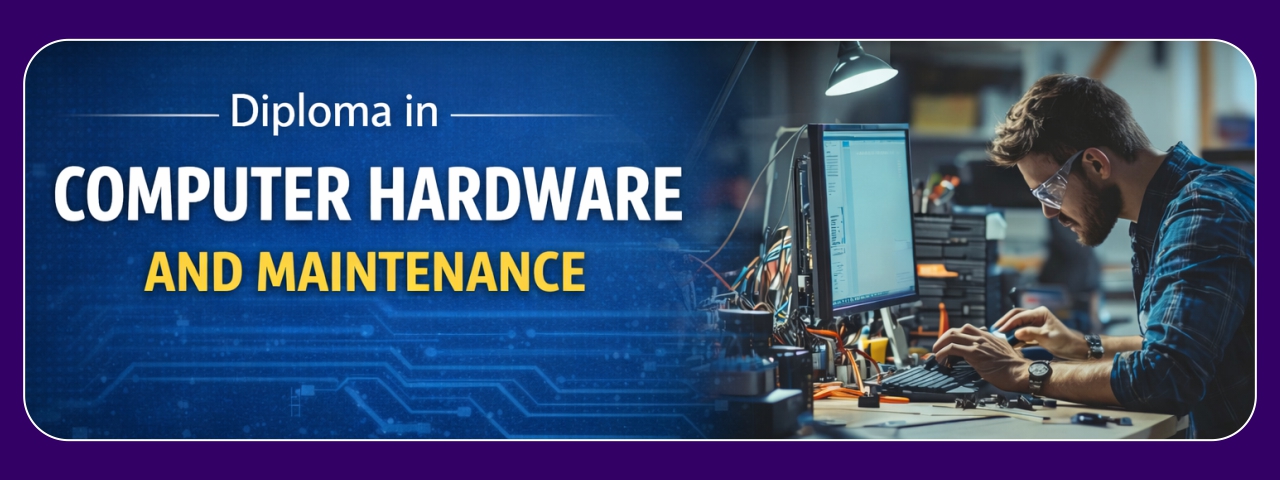
Computer hardware is a fascinating branch of computer science. Candidates interested in a career in this profession will need to take hardware and networking courses. This discipline offers a variety of certifications, diplomas, and undergraduate and postgraduate-level courses. The computer hardware eligibility criteria differ depending on the level of course chosen by applicants. Admission to computer hardware courses can be obtained by an entrance test or through merit. MAH MCA CET, IPU CET, SET, BU MAT, and other prominent admission examinations may be taken by those who want to study computer hardware at any top college. Computer hardware is a vital component of computer science. Candidates wanting employment in this industry must complete a computer hardware course. There are several short- and long-term courses available in this field after completing the 12th grade. Chips, operating devices, motherboards, processors, RAM, circuit boards, modems, external hard drives, printers, and keyboards are all handled by hardware personnel. To be effective in this field, one must be familiar with all of the hardware components. These courses are available both offline and online. Computer courses are now available at the graduate, postgraduate, and diploma levels. Aside from that, there are several certifications available through institutions and internet organizations like Coursera, Udemy, etc.
Course Highlights
Computer hardware courses are in high demand as the IT sector continues to grow. Candidates who have completed computer hardware and networking courses can pursue professions in a variety of industries, such as businesses, government agencies, and educational institutions.
| Particular | Details |
| Popular Courses | DCHN, DCHM, ADCHM, etc |
| Eligibility | Candidate must pass class 12 from a recognized board |
| Duration | 1-2 years |
| Top Colleges | Uttar Pradesh's Aligarh Muslim University, Government Polytechnic, and Vivekananda Global University |
| Average Fees | INR 5,000-30,000 |
| Average Salary | INR 2 to INR 5 LPA |
| Top Job Prospects | Engineer in Systems Integration, Design Engineer, Field Service Engineer, Project Engineer, Systems Engineer |
Eligibility Criteria
The qualifying criteria for diploma and postgraduate diploma courses differ. While a diploma in computer hardware can be pursued after graduating from high school, a PG diploma, or postgraduate diploma, can be pursued after graduation.
- In comparison to expanded instruction in full-time bachelor's and master's degrees, diploma courses provide specialized knowledge.
- While diploma courses are one year in length, PG Diploma courses can be one or two years in length.
- These courses are also favored by students who wish to enter the workforce quickly rather than devote years to detailed study.
- Diploma computer courses, like certificate programs, allow you to select from a wide range of specializations.
Diploma and PG Diploma computer hardware courses are ideal for students looking to save money while pursuing a more career-oriented education. In India, the average income for post-diploma courses ranges from INR 2 lakh to INR 5 lakh.
Before applying for admission, candidates should review the computer hardware course qualifying criteria. The qualifying standards differ from one institute to the next. Examine the qualifying criteria for computer hardware courses listed below.
- Candidates who have passed their class 12 board examinations are eligible to apply for admission to these programs.
- Admission to certificate and diploma programs is direct; however, some schools require a simple exam to check a candidate's technical competence before giving a place in the course.
Computer Hardware Course Entrance Exams
Admission to computer hardware diploma programs is often based on merit. If you wish to pursue a bachelor's or master's degree in computer hardware, however, many universities recognize the entrance test as a means of admission. These exams are given at the national, state, and university levels. Check out the following list of prominent computer hardware entrance tests:
The IPU CET
The IPU CET (Indraprastha University Common Entrance Test) is a university-level test. This entrance test is used to determine admission to programs such as engineering, law, computer applications, management, and others. The IP University entrance exam will be used to admit students to UG, PG, and other degrees.
Pre-MCA CG
The CG Pre-MCA 2022 Entrance Exam is another name for the Chhattisgarh Pre-MCA Entrance Exam. This exam is administered once a year by the Chhattisgarh Professional Examination Board. In Chhattisgarh, many government and private colleges provide MCA programs to qualified students.
GITAM Science Entrance Exam (GSAT)
GSAT PGTA is an abbreviation for GITAM Science Admission Test Postgraduate 2023, which is given by GITAM University. For admission to M.Sc. and MCA programs, the test is given once a year.
NIMCET
The NIMCET, or National Institute of Technology Master of Computer Applications Common Entrance Test, is a test for admission to MCA programs. This entrance exam is administered each year to provide admission to Masters in Computer Application (MCA) programs at participating NITs.
Admission Procedure
The admission process for computer hardware courses is determined by the level of study. The admission process for graduate-level computer hardware courses differs from that of postgraduate courses. Go over the information provided below to obtain a better understanding of the computer hardware courses' admission procedure.
- For Diploma courses, the merit of the Class 12 result is considered, whereas the merit of the Graduation score is considered for the PG Diploma.
- Students must fulfill specified computer course eligibility criteria, one of which is a graduation degree, to be accepted for the PG diploma program.
- Many institutes now provide direct entry into diploma programs.
Top Hardware Diploma Programs
The following are some of the most popular diploma courses available in the field of computer science:
- Diploma in Computer Hardware Maintenance
- Diploma in Computer Engineering
Fees Structure
The cost of a Diploma in Computer Hardware and Maintenance program varies depending on the institution and university. Diploma in Computer Hardware and Maintenance course costs in India range from INR 5,000 to INR 30,000.
Subjects & Syllabus
Computer hardware courses cover topics such as computer organization and electrical and electronic circuits and are offered both online and offline. Candidates who complete this course can work as computer hardware engineers, computer support specialists, computer and information researchers, architects, and others. These courses cover IT, electrical, and computer circuits separately and teach students to recognize and address the hardware of computers and other similar devices. Examine the computer hardware course syllabus and subjects for diploma, undergraduate, and postgraduate programs listed below.
Syllabus for the Diploma in Hardware and Networking
A Diploma in Hardware and Networking Technology is a curriculum in information technology. The training provides graduates with a competitive advantage in the IT industry. Examine the Diploma in Hardware and Networking Syllabus, which is provided below.
| Subjects |
| Information Technology Fundamentals and Operating Systems |
| Basics of Electronics & Microprocessors |
| PC Assembling & Troubleshooting |
| Information Technology Fundamentals and Operating Systems |
| Communication & Soft Skills |
| Programming in C |
| Computer Networks |
| 1st Software Lab |
| Windows 2003 Server Administration |
| Linux Administration |
| Software Lab-1 (Windows 2003 Server & Linux) |
| Database Administration |
Placement
Candidates who have finished computer hardware and networking courses will be able to work in a variety of sectors, ranging from start-ups to MNCs, because all businesses want qualified personnel who can manage technology and network issues. Positions are also available in government agencies and educational institutions. Any of the tasks that computer hardware professionals may investigate are listed here.
| Jobs | Average Annual Salary |
| Computer Support Specialist | INR 5.3 LPA |
| Computer Hardware Engineer | INR 2 LPA |
| Computer and Information Research Scientists | INR 32.3 LPA |
| Computer Operator | INR 2 LPA |
| Network Architects | INR 14.8 LPA |
| Network Designer | INR 6 LPA |
| Hardware Executive | INR 3.6 LPA |
| System Engineer | INR 4.4 LPA |
Course Scope
Because the computer business is one of the fastest-growing sectors in India today, there are several employment opportunities in computer hardware courses. A job following computer hardware education is fantastic since India's IT industry is thriving and trained individuals are in high demand across a wide variety of industries. Examine the information regarding the computer hardware course scope provided below.
Cloud computing is a network of servers that store data and make it available over the internet. These servers are driven by specific software and databases that must be regularly updated. Cloud technology and information security are currently employed by almost every type of organization in India to store data and secure important information. This qualification allows professionals to work as cloud engineers, information security engineers, and information security analysts.
Machine learning and artificial intelligence are complementary fields with huge promise. AI and machine learning are increasingly being incorporated into business processes in India. Machine learning (ML) is a technique that trains machines to learn automatically by evaluating available data, whereas AI-based technology is known for mimicking human behavior. Both of these professions are rapidly increasing in India, with huge future promises. This training allows professionals to work as AI engineers, ML engineers, AI specialists, data scientists, data analysts, software engineers, and technical architects, to name a few.