October 19th, 2026
FMS - Faculty of Management Studies, University of Delhi
Picture yourself being admitted to a management school in India paying only about ₹2.43 lakh for two years of tuition and then stepping into a job market where the average placement offer exceeds ₹32 lakh per year. Such figures make students pause and examine the Faculty of Management Studies or FMS at the University of Delhi. The true appeal of FMS goes beyond the numbers. For MBA hopefuls FMS offers a chance to study at a highly respected business school without shouldering the enormous fee load that many other top B‑schools demand.
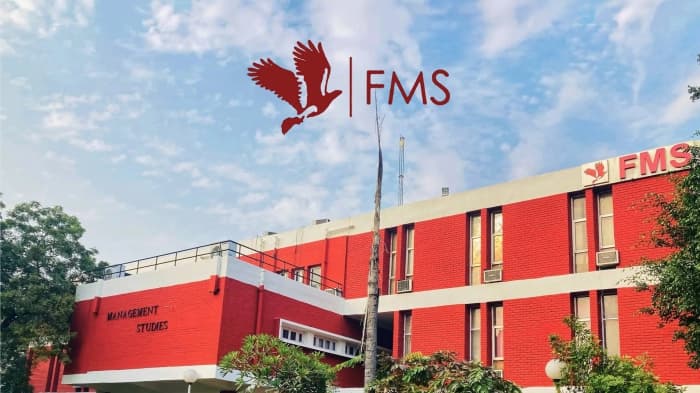
FMS Delhi is not a business school that stands alone. It is a public management school that belongs to the University of Delhi, one of India’s famous public universities. Founded in 1954 FMS has spent over seventy years building a reputation in management education. A powerful alumni network, tough admissions and a strong placement record have turned FMS into a dream spot for thousands of students. The distinctive red‑brick building and the hopes that come with admission give FMS the nickname "Red Building of Dreams".
FMS is attractive because it balances fees, high-quality academics, a strong peer group and great career prospects. Getting into FMS is, however, not simple. The admission process is very competitive. Students must bring more than a good academic record to stand out. Knowing the course structure eligibility rules, entrance test requirements and selection steps is therefore vital before setting FMS as a goal.
In this guide we will examine FMS Delhi from every angle: its history, its growth, its MBA and other management programmes, the admission process, academics, campus life, student culture, placements and career prospects. We will also compare FMS with the IIMs, explain why its return on investment is seen as exceptional and outline what an aspirant can do to prepare from entrance exam study to finally walking into the Red Building of Dreams.
History and Legacy: Seven Decades of Building a Name
Long before students started thinking of a MBA from a business school as a usual career path, FMS Delhi was already teaching management in India. The Faculty of Management Studies was set up in 1954 under Delhi University making FMS one of the most aged management schools in the country. In fact FMS began before most of the IIMs that students talk about today. FMS started on a small scale as a management education project inside Delhi University but over time FMS grew into a full Faculty with its own identity, programmes and academic community. Being part of Delhi University gave FMS a character from many private or autonomous business schools. FMS was created as an institution with its academic roots firmly tied to a major university rather than as an independent private business school. Over the years FMS programmes expanded, teaching changed with the evolving business world and FMS presence became closely linked to Delhi University’s North Campus. This long journey is a reason why FMS today is not only known for low fees and high placements; it carries a history that goes back more than seven decades.
An institution's legacy is not made by age alone. People build it. Over the years FMS has produced graduates who have gone on to work in business, consulting, finance, entrepreneurship, public service and other fields. These alumni have helped carry the FMS name into industries and countries, strengthening the FMS professional network with every graduating batch. The growth of its programmes, recognition and the continued success of students and alumni have all added new layers to the FMS story. From a small management education initiative to one of India’s, sought-after public business schools is perhaps the most important part of the FMS legacy.
Location and Campus: Small in Size, Big in Character
One of the things that makes FMS Delhi instantly recognisable is the place where it’s located. FMS Delhi is situated in the North Campus of the University of Delhi in the centre of one of the city’s most lively student zones. Then there is the building itself, the well‑known red‑brick structure that has become closely linked with the FMS identity. The building may not have lawns, large academic blocks or shiny modern infrastructure that some newer B‑schools provide but that is also part of the building’s charm. Being inside the Delhi University ecosystem means FMS students are surrounded by libraries, university resources, student activities, societies and the broader cultural life of North Campus. The location also places FMS students in a setting where college life does not stop at the classroom door.
FMS also has access to hostel facilities and essential campus amenities. The overall campus experience is more compact than the experience students may find at many IIMs. This difference is worth understanding. Several IIM campuses are arranged like self‑contained residential towns, with large academic areas, hostels, sports facilities and wide open spaces. FMS in comparison feels much more like an university‑based management school. The campus is smaller and more heritage‑driven. The campus has a character that comes from decades of student life. For students, walking into the familiar red‑brick building is not about entering a huge modern campus, it is about becoming part of a place that has been linked with management education for generations.
Programs Offered at FMS Delhi
FMS Delhi does not offer management courses simply to have a variety. Its main programmes are designed for stages of a person’s academic or professional journey. There is a full‑time MBA for students who want to start a career in management, evening executive programmes for those who are already working and a doctoral programme for those who wish to study management research more deeply. Each programme has a different aim so choosing among them is less about which one is "best" and more about which one matches the current career stage.
1. MBA (Full-Time)
The MBA Full‑Time is the programme that most people think of when they hear FMS Delhi. It is a two‑year programme that focuses on management fundamentals, hands-on learning and career preparation. Admission to this flagship programme uses the CAT score, which makes it one of the competitive management admission routes in the country. In the first year the focus is on building a strong base in many business areas. In the second year students can shape their learning around their career interests. A summer internship is offered between the two years allowing students to see how the ideas taught in class work in a real company.
Programme highlights
- Duration: 2 years
- Mode of learning: Full‑time
- Approx. Fees: Around ₹2.43 lakh for the two‑year programme although the fee structure can change.
2. FMS Delhi Executive MBA
Not every person who wants an MBA is ready to quit their job for two years. That is why the FMS Delhi Executive MBA is useful. It is made for working professionals and is a two‑year evening programme that lets them keep working while studying management. Classes are usually held Monday to Friday evenings, sometimes longer on Saturdays. The course covers finance, marketing, HR, operations, strategy and entrepreneurship. It also uses visiting scholars,live projects, masterclass and corporate liaison to link classroom learning with real workplace situations.
Programme highlights
- Duration: 2 years
- Mode of learning: Part‑time, evening classes; Monday–Friday with Saturday sessions when scheduled
- Approx. Fees: Fee varies by admission cycle; applicants should check the FMS admission bulletin for the current amount.
3. MBA Executive (Health Care Administration)
The MBA Executive (Health Care Administration) follows an evening part‑time format but has a much narrower focus. In lieu of covering management in a general business setting it brings management education into the healthcare sector. The programme mixes management with public health and hospital administration making it especially relevant for professionals who already have an academic and professional background in healthcare. Like the Executive MBA it lets professionals keep working while earning the degree.
Programme highlights
- Duration: 2 years
- Mode of learning: Part‑time, evening programme
- Approx. Fees: Fee varies by admission cycle; the latest FMS bulletin should be checked before applying.
4. PhD / Management Doctoral Programme
If someone wants to go beyond learning how businesses are managed and wants to study, question and create knowledge about management, FMS offers a Doctoral Programme. Research areas include finance and accounting, marketing, strategy and management organisational behaviour and HR, operations, information technology, economics and public policy. Applicants must pick a research area and submit a research proposal. Admission requires a qualifying route such as UGC‑NET, CSIR‑NET or an equivalent followed by FMS selection and an interview.
Programme highlights
- Duration: Varies according to requirements and university regulations
- Mode of learning: Full‑time doctoral research
- Approx. Fees: Varies by the University of Delhi/FMS fee structure.
Admissions Process- Full-Time MBA
Getting into FMS Delhi is not something that happens by filling out a form and scoring well on the CAT. It is a process with several steps and each step plays a big role. The journey starts with checking if the basic eligibility criteria are met. For the full-time MBA programme a candidate must have completed a Bachelor’s degree after 12 years of schooling. For candidates in the category the minimum requirement is 50% marks or an equivalent CGPA. The rules are a bit more relaxed for some categories. SC and ST candidates only need to have passed their exams. OBC-NCL, EWS, PWD and CW candidates usually need at least 45% as per the University of Delhi guidelines. Students who are in their year of bachelor’s degree can also apply, as long as they meet the requirements when their final results come in.
Step 1: CAT Comes First
For the MBA programme the CAT exam is the main gateway. There is no entrance test for FMS that students can take instead of CAT. A candidate first needs to take the CAT exam and then apply to FMS according to the instructions. For the CAT 2026 cycle the tentative dates are November 29 2026 for the examination. Registration is expected from August 3 to September 25 2026. Results are likely to be released in mid-to-late December. These dates should be confirmed against the CAT notification once it is published.
But here’s something important: a high overall CAT percentile does not automatically mean you will get an interview call from FMS. The institute uses a weighted CAT score when shortlisting candidates. Each section of the CAT carries importance. According to the FMS guidelines VARC has a weight of 40% while DILR and QA each carry 30%. Also women candidates receive 5 marks during the shortlisting phase.
Step 2: Understanding the Cutoff and Composite Score
This is where many aspirants get confused. There is a difference between the CAT score used for shortlisting and the final composite score used for admission. FMS does not decide based on CAT. Once candidates reach the interview stage, their academic history and performance in selection activities become part of the evaluation.
| Component | Weightage | Notes |
| Weighted CAT Score | 50% | General cutoff 99+ percentile; EWS/NC-OBC 91+; SC 75+; ST 60+ |
| Class X Marks | 10% | 60–75%: 5%; 75%+: 10% |
| Class XII Marks | 10% | 60–75%: 5%; 75%+: 10% |
| SOP Discussion | 10% | Conducted individually |
| Extempore | 5% | 1–2 minutes, conducted individually |
| Personal Interview | 15% | 20–25 minutes |
| Gender Diversity Bonus | +5 marks | Awarded to female candidates |
For Class X and Class XII marks FMS gives 5% for scores between 60% and below 75% and 10% for 75% or above. The actual CAT cutoff needed to secure an interview call can vary from year to year. So relying on a year's safe percentile as a fixed rule might not work. Candidates should stay updated and prepare accordingly.
Step 3: The Interview Stage
If a candidate makes the shortlist the process becomes more personal. They will face a Statement of Purpose, discussion an extempore and a personal interview. The SOP discussion is not about how well the statement was written. It helps the panel understand the candidate's thought process, goals and decisions. The extempore tests the ability to think and speak clearly without preparation. The personal interview brings all aspects together. Background, awareness, career plans, personality and the ability to engage in conversation effectively.
The exact interview schedule changes every year. The selection process usually begins after CAT results are released. Candidates should start preparing for this stage well before the shortlist comes out. Waiting until the last minute is risky and may leave no time for proper preparation.
One FMS Myth Worth Clearing Up
There is no management quota through which a student can pay extra and get a seat in the MBA programme. The admission process follows published criteria. Selection depends on CAT score, academic record and performance in interviews. Money cannot buy a place. That is one reason why competition for seats at FMS's so fierce. Merit always comes first.
FMS Delhi Executive MBA. Admission, Eligibility & Fees
The FMS Delhi Executive MBA is aimed at people who are already working and want to move into managerial or leadership roles. Instead of leaving a job for two years professionals can study in the evening while keeping their careers going. This makes the programme very different from the full‑time MBA.
FMS Delhi Executive MBA eligibility
The FMS Delhi Executive MBA eligibility focuses on education and work experience. Candidates generally need:
- A 3‑year bachelor’s degree after Class 12
- Minimum 45 % aggregate marks
- Degree from Arts, Commerce, Science, Law, Engineering, Medicine or an equivalent field
- least 5 years of executive/administrative work experience counted as of April 1 of the admission year
- NOC from the current employer
- Regular attendance is compulsory so candidates must be able to attend classes in Delhi/NCR
For the Health Care Administration programme eligible backgrounds include MBBS, BDS, BAMS, BUMS and BHMS with 45 % or relevant master’s degrees with 55 % along with the required work experience.
FMS Delhi Executive MBA admission
The FMS Delhi Executive MBA admission process does not require CAT. Instead candidates are assessed through their professional profile, SOP, extempore and personal interview. The general programme has around 200 seats while Health Care Administration has around 60 seats. Applications generally open after the full‑time MBA admission cycle with the recent cycle extending until around mid‑January.
FMS Delhi Executive MBA fees
The FMS Delhi Executive MBA fees for the 2026 cycle are approximately ₹2.43 lakh for the two‑year programme. This is ₹1.16–1.22 lakh, per year depending on the applicable fee structure. Compared with private Executive MBA or PGDM programmes that can cost around ₹8–20 lakh, FMS remains a relatively affordable option. Fees can however be revised according to University of Delhi guidelines.
FMS Delhi Executive MBA duration
The FMS Delhi Executive MBA duration is 2 years. It follows a part‑time, evening format, with the curriculum moving from management subjects to more specialised courses and electives. In terms the FMS Delhi Executive MBA programme is built for professionals who want to study management without putting their existing career on hold.
| Selection Component | Weightage |
| Class XII Marks | 10 marks |
| Graduation Marks | 25 marks |
| Statement of Purpose (SOP) | 25 marks |
| Extempore | 15 marks |
| Discussion on Executive Experience | 10 marks |
| Personal Interview | 15 marks |
Fees Comparison Across Programs
One of the ways found to see why FMS Delhi has a good return on investment (ROI) is to look at fees across different programmes. Whether the programme is the two-year MBA, the Executive MBA for working professionals, the specialised Executive MBA in Health Care Administration or the PhD programme FMS Delhi uses a fee structure that is quite different from the fees many students see at private business schools. The regular MBA is especially striking because students can access a known management education without paying the very high tuition fees often linked to expensive schools. The Executive programmes also keep the cost manageable for working professionals while the doctoral programme follows a fee structure suited to research. Course ROI is not only about paying less and earning more – factors such as career growth, placements, alumni network and the quality of learning matter too. Still when a respected public institution combines low fees with strong career outcomes the numbers naturally stand out. The table below puts the fees of FMS Delhi's programmes side by side making it easier to see where this ‘well known for best ROI’ in India reputation comes from.
| Program | Duration | Total Fees | Eligibility | Admission Basis | Seats |
| MBA (Full-Time) | 2 Years, Full-Time | ~₹2.43 Lakhs | Bachelor's degree, 50% (45% reserved) | CAT + SOP + Extempore + PI | 251 + 63 supernumerary |
| Executive MBA | 2 Years, Part-Time | ~₹2.43 Lakhs | Bachelor's degree, 45% + 5 yrs experience | Academics + SOP + Extempore + PI | ~200 |
| Executive MBA (HCA) | 2 Years, Part-Time | ~₹2.43 Lakhs | Medical/allied degree + 5 yrs experience | Academics + SOP + Extempore + PI | ~60 |
| PhD | Full-Time/Part-Time | ~₹52,400 | Master's degree, 55% | UGC-NET/CSIR-NET/equivalent + Interview | Varies |

Placements at FMS Delhi
Placements for the full‑time MBA are a reason why students compete hard for a seat at FMS. Recent placement reports show a package of about ₹32–34 LPA with some offers higher. Recruiters from industries visit the campus so students can choose from many career paths.
Major recruiting sectors include:
- Consulting
- BFSI and Finance
- FMCG
- E‑commerce
- Technology
The full‑time programme also has a placement rate to 100 %. Because of this campus recruitment is a part of the FMS experience.
FMS Delhi Executive MBA placement
Placements look different for the Executive MBA at FMS Delhi. FMS does not publish official placement data for the Executive MBA mainly because most students in this programme already work. They attend the course to sharpen skills, move into roles or grow within their current jobs rather than rely on campus recruitment.
Unverified data suggests salaries for Executive MBA graduates range from ₹15–22.6 LPA. These numbers vary a lot depending on a person’s experience, industry and job role. Because of this variation these figures should not be treated as FMS placement data.
Alumni Advantage
The advantage of FMS does not end when students leave the campus. A strong alumni network helps graduates connect with recruiters, industry experts and new career opportunities. For full‑time MBA students this network can aid placement. For working professionals it can help long‑term career growth and mobility. In short FMS provides placement opportunities for its full‑time MBA. The Executive MBA on the other hand is aimed at career growth, for people who already work.
Short-Term Courses at FMS Delhi: Quick Upskilling, Big Brand Value
Many professionals choose Short‑term Courses for skill building. Not everyone can spare two years for an MBA , and FMS Delhi understands that. In addition to its flagship MBA and Executive MBA programmes FMS offers a variety of Short‑term Courses. These Short‑term Courses are for working professionals, executives and even defence officers who need practical learning while staying at their jobs. Short‑term Courses are shorter and sharper. Still hold the same FMS/Delhi University credibility that gives the full‑time programmes their respect. Think of Short‑term Courses as quick high‑impact stops that focus on skills such as sales, finance, leadership and strategy instead of a full management degree.
Short-Term Courses Offered by FMS Delhi
Management Development Programme (MDP)- Management Development Programme (MDP) is a focused programme that sharpens practical skills such as sales, marketing and financial management for working executives.
Program Highlights:
Mode of Learning: On-campus classroom-based
Duration: 1 day to a week depending on the module
- Approx. Fee: Varies by module (check with FMS for the batch)
General Management Programme for Defence Officers (Certificate)- General Management Programme for Defence Officers (Certificate) is a designed course that helps Indian Armed Forces officers transition smoothly into corporate and management roles.
Program Highlights:
- Mode of Learning: On-campus
- Duration: A few weeks
- Approx. Fee: Not fixed publicly; usually coordinated through defence channels
Executive Development Programmes (EDPs)- Executive Development Programmes (EDPs) are industry‑focused sessions that cover operations, strategy and leadership. They are usually offered to corporates or specific professional groups.
Program Highlights:
- Mode of Learning: On-campus blended
- Duration: A few days to a couple of weeks
- Approx. Fee: Varies by program and sponsoring organization
(Focus on Short‑term Courses: FMS does not publish a fixed fee list for these programmes because batches and modules change regularly. It is best to check the FMS Delhi website or contact admissions for the latest fee for a particular course.)
| Course | Duration | Mode of Learning | Who It's For | Approx. Fee |
| Management Development Programme (MDP) | 1 day – few weeks | On-campus | Working executives/professionals | Varies by module |
| General Management Programme for Defence Officers | Few weeks | On-campus | Indian Armed Forces officers | Not fixed publicly |
| Executive Development Programmes (EDPs) | Few days – few weeks | On-campus / blended | Corporates, industry professionals | Varies by program |
FMS vs IIMs vs Other B-Schools
Choosing between FMS, the IIMs and other B-schools is not really about finding one winner. Each has something to offer. The IIMs, the older ones, have a very strong brand name, large campuses, bigger batches and wide international exposure. Many also offer infrastructure and a huge range of academic and student activities. Private B-schools can also provide campuses, specialised programmes and strong industry connections. FMS however plays a different game. Its biggest strength is the combination of a selective admission process, a long academic legacy and a much lower fee burden.
| Factor | FMS Delhi | IIMs | Other B-Schools |
| Fees | Very low compared with most top B-schools | Usually much higher | Varies widely |
| ROI | Exceptional, mainly because of low fees and strong placements | Strong, but higher fees can increase the investment | Depends heavily on the institute |
| Selectivity | Extremely competitive | Extremely competitive | Depends on the B-school |
| Brand | Very strong, especially in India | Very strong, with wider global recognition for leading IIMs | Depends on the institute |
| Campus | Compact university campus | Generally larger residential campuses | Often modern and spacious |
| Exposure | Strong industry and alumni exposure | Strong industry, international and academic exposure | Varies by school |
The real FMS advantage becomes clearer when the cost of education enters the picture. A student can access a top-level management education without taking on the kind of fee burden seen at other leading schools. This is why FMS has developed such a ROI (return on investment) image. On the other hand , students who place a very high value on a large residential campus, international opportunities or a wider global brand may find some IIMs more attractive.
The same thinking applies to education. The FMS Executive MBA program can be a value-driven option, for working professionals who want a recognised management qualification without paying the higher fees charged by many private Executive MBA or PGDM programmes. So the choice ultimately comes down to priorities: FMS stands out when affordability, selectivity, legacy and career returns matter most while some IIMs and private B-schools may offer advantages in scale, infrastructure or international exposure.

Conclusion
FMS Delhi has built something that's hard to find in management education: a strong legacy without a high fee burden. The full‑time MBA is the draw for students who want to enter the management world while the Executive MBA FMS Delhi route gives working professionals a chance to step up without putting their careers completely on pause. Different programmes, students, but the same FMS identity runs through both.
So which path is right for you? If you are a student who wants to focus on management studies and start a new career, the regular MBA is the best choice. If you are a professional who has worked for years and wants better managerial roles the FMS Delhi Executive MBA might be the smarter option. Remember neither path is a shortcut. FMS is very selective. The value you get still depends on what you bring to the classroom and what you do after you finish.
The business world will keep changing. India's B‑school scene will change as well. New institutes, new courses and new ways of learning will keep appearing. FMS’s biggest strength is that its appeal is not based on a passing trend. Low cost, academic roots, competitive peer learning and career opportunities stay valuable no matter how the MBA market shifts. That is why more than seventy years after it started the red building still draws students who think a great management education does not need a huge financial burden.