
August 19th, 2026
Let's think about how much we depend on machines in our daily life. We get parcels delivered to our doorstep really fast, automobiles are made in less time and products in stores are made on a huge scale. Mechanical Engineers and machines are behind many of these changes. They are doing work that used to take hours for people to do. This is happening in countries around the world, and is changing the way people work and the way companies function.
The use of robots is not just an idea for the future. It is happening now and is happening at quite a good pace. The International Federation of Robotics (IFR) reported that 542,000 industrial robots were installed around the world in 2024. This is more than twice the number of robots that were set up ten years ago. It shows how fast industries are moving towards using machines that can think and work on their own.
This change is creating opportunities for Mechanical Engineers. Earlier Mechanical Engineering was mainly about machines making things, engines and systems that move. Today these areas are being combined with robots, sensors, software, artificial intelligence and machines that can work on their own. Because of this, students who study Mechanical Engineering can look at new career options in robots and automations.
As AI in education continues to change how students learn and develop technical skills, Mechanical Engineering programmes are also adapting to include robotics, automation and artificial intelligence.
Students exploring technology-focused careers can also consider top indian colleges offering B.Tech in AI, which provide programmes focused on artificial intelligence, automation and emerging technologies.
The growth of Industry 4.0 is making this change happen faster. Factories that use machines, machines that are connected, production that is automated and systems that use data are becoming a part of modern industries. For students who want to study B Tech Mechanical Engineering, learning about robots and mechanization can be a step towards building a career that is ready for the future.
This article looks at how robots and machines that can work on their own are changing Mechanical Engineering. It also talks about the best degree programmes, career options, salary prospects and important skills needed to build a career, in this growing field of Mechanical Engineering and robots.
What Is Robotics and Automation Engineering - How Is It Different From Mechanical Engineering?
Imagine you walk into a factory. You see robots moving parts around, machines checking products and computer systems controlling tasks. Most of these jobs happen with little help from people. This is what robotics and automation engineering is about. It is about building machines and systems that can do work by themselves safely and accurately.
Robotics and automation engineering is closely related to engineering. Mechanical engineering teaches you how machines work, how to design them and how to build parts. These basics are very important when creating a robot. Areas like mechatronics and robotics engineering, machine design, manufacturing and mechanical systems are all part of robotics and automation engineering. But robotics and automation engineering does not stop with mechanical parts.
A robot also needs sensors, electronics, computer programs and control systems to work properly. This is where mechanical engineering connects with electronics, computer science and artificial intelligence. Engineers work with areas such as design, control systems, embedded systems, sensors, programming and artificial intelligence. Today artificial intelligence robotics is also growing quickly, helping robots understand information and make decisions.
Robotics and automation engineering is already being used in industries around the world. In Germany, robots and automation systems are widely used in the automobile industry to build and assemble cars. In the USA robotics and automation engineering is used in areas such as aerospace and manufacturing. Japan and South Korea use robots and automation systems heavily in electronics and factories. Logistics companies such as Amazon and DHL use robots and automation systems to sort, move and manage packages.
So how is a mechanical design engineer different from a robotics and automation engineer? A mechanical design engineer mainly designs machines, products and mechanical parts. A robotics and automation engineer works on a system. They may design the robot's body, add sensors and electronics, write programs and make sure the robot can perform its task.
In terms mechanical engineering focuses mainly on building the machine while robotics and automation engineering focuses on building the machine and making it work automatically. This combination is also why artificial intelligence, robotics and automation engineering are becoming a part of modern industries. Robotics and automation engineering is a field that combines engineering, electronics, computer science and artificial intelligence to create machines and systems that can work by themselves.
The World Really Needs Robotics and Automation Engineers Right Now
Think about it, much work is being done by machines these days. A robot can actually put together a car, a machine can sort hundreds of packages in no time and a computer can control an entire production line all by itself. Jobs that used to need a lot of people can now be done with the help of machines.. This does not mean that people are not needed anymore. Companies now need people who can build these machines, control them, fix them when they break and make them work better. This is why robotics and automation engineers are becoming really important around the world.
The growth of robotics is pretty clear when you look at the numbers. According to the International Federation of Robotics 542,000 industrial robots were installed around the world in 2024. That is double the number that was installed just ten years ago. Most of these robots were installed in Asia. China is the user of industrial robots followed by Japan, the USA, South Korea and Germany. Singapore also has one of the numbers of robots compared to the size of its manufacturing industry.
The robotics market is growing fast as more companies start using machines for their work. One estimate from 2025 says that the global robotics market is US$50 billion. By 2030 it could grow to around US$111 billion. The World Economic Forum has also said that artificial intelligence, robotics and other new technologies are changing the types of jobs that companies need. This means that engineers with technology and automation skills are likely to have opportunities in the coming years. Robotics and automation engineers are really in demand.
Where Are Robotics Engineers Needed?
Robots are not just used in factories. They are now being used in different areas.
Robotics Is Becoming Smarter
Robots are also changing the way they work. Collaborative robots, also called cobots, are made to work with people. They can help workers with repeated jobs instead of replacing the whole team. Robotics and automation engineers are working on these robots.
Another growing technology is mobile robots. These robots can move around a warehouse by themselves. They can carry products, find their way and take items to the right place. Robotics and automation engineers are needed to make these autonomous mobile robots work.
There is also a focus on smart manufacturing. In words this means machines, computers, sensors and people work together and share information. Artificial intelligence can make these systems even better by helping machines understand information and make decisions. Robotics and automation engineers are a part of this.
All of this is part of Industry 4.0 where technology is making industries more connected and automated. As companies adopt these technologies they need engineers who understand both machines and modern technology. This is why robotics and automation can offer career opportunities for mechanical engineers and other engineering students, around the world. Robotics and automation engineers have a future.
How to Become a Robotics and Automation Engineer- Degree Pathways Around the World
There is no set rule to become a robotics and automation engineer. Some students choose robotics directly after school. Some students study engineering first and move into robotics later. Nine to fivers can also learn robotics through courses and short programmes. The best option depends on what a student wants to do, how much time they have and what they can afford.
Starting After 12th: Robotics Engineering After 12th
For students thinking about robotics engineering after 12th a bachelors degree is a place to start. Students who have studied mathematics and physics can apply for engineering courses. However every university and country has its admission rules.
Every university has its rules for robotics and automation engineering.
There are a few choices:
Students can find robotics and related engineering programmes in countries such as the USA, UK, Germany and Australia. Some known universities with strong programmes in robotics and related areas include:
A baccalaureate usually takes around 3 to 4 years depending on the country and university. A degree is not the only thing that matters. Students should also try to get some experience. Simple automation projects, internships, college labs and robotics competitions can help students understand how robots work in life. Real life experience is very important for robotics and automation engineers.
Masters in Robotics and Automation: The Next Step
After completing their first level degree students can go for a masters in robotics and automation. This can be helpful for students who want to learn more about robotics and take up next level engineering or research jobs.
A masters course can include topics such as:
Many universities offer masters in robotics and automation. There are also two types of masters courses:
Industry-Focused Master's Programmes
These courses focus more on practical work, projects and skills that companies use. They are a good choice for students who want to work in robotics, automation and technology companies after completing their master's.
Some popular programmes include:
MS in Robotic Systems Development (MRSD) – Carnegie Mellon University, USA. It focuses on robot development, automation, systems and industry projects.
Research-Focused Master's Programmes
These courses focus more on research, experiments and developing new ideas. They can be useful for students who want to go into research or study for a PhD later.
Some popular programmes include:
Global Universities for Robotics and Automation
Some known universities for advanced robotics and related studies include Carnegie Mellon University, Georgia Tech, ETH Zurich, TU Delft, KTH Royal Institute of Technology, the University of Twente and the University of Tokyo.
These universities offer different types of robotics and related master's programmes. Students can choose a course based on whether they want to work in the industry or continue with research. Robotics and automation engineers can choose industry-focused or research-focused courses.
A masters degree generally takes around 1 to 2 years depending on the university and country. International students can also look for scholarship awards, university funding and research assistant opportunities to cut the cost of studying.
Robotics Engineering Courses for Working Professionals
A robotics and automation degree is not the only way to learn robotics. People who are already working can also learn skills through online courses and short programmes. Hence, working professionals can also learn robotics and automation. Websites such as Coursera, edX and MIT OpenCourseWare propose courses in robotics, programming, automation and AI. Professionals can also learn skills such as:
These robotics engineering courses can be very useful for mechanical engineers who already know about machines but want to learn more about modern robotics.
For example a mechanical engineer may already know how to design a machine. By learning programming, sensors, electronics and robot control the engineer can slowly move towards robotics-related jobs.
So the professional development into robotics does not have to start from the beginning. A student can study robotics after 12th choose B.Tech Mechanical Engineering and specialise later or learn robotics skills while already working. The important thing is to build knowledge in machines, electronics, programming and automation.
What Competencies Does a Robotics and Automation Engineer Need in 2026?
Robotics and automation engineering is not about building robots. A robotics and automation engineer needs to understand how machines work, how to control machines, how to use software to operate machines and how to fix problems when machines do not work properly. As technology changes all the time, robotics and automation engineers also need to learn tools and new ways of doing their job.
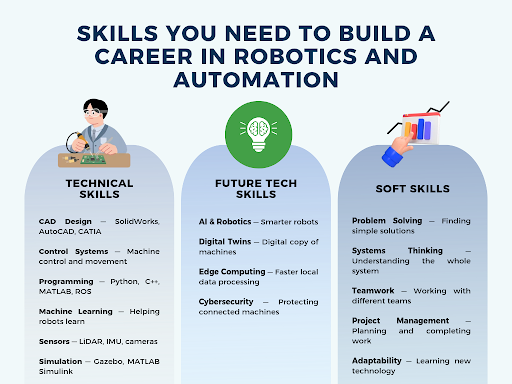
What Employers Want:-
Companies like Siemens, ABB, FANUC, Boston Dynamics, Tesla and Amazon Robotics want to employ people who can understand both machines and technology. They want robotics and automation engineers who can work with people, solve problems, learn new tools and do real work.
To get a job a robotics and automation engineer needs to have a mix of engineering knowledge, programming skills, automation skills, artificial intelligence skills and problem-solving skills. Working on projects, doing internships and getting hands-on experience can also make a difference when looking for a job.
The good thing is that robotics and automation engineers do not need to learn all these skills at. Students can start with the basics of robotics and automation engineering. Then add more skills as they go through college work, on projects, take courses and practice. Even people who are already working as engineers can learn tools and move into robotics and automation engineering step by step.
Career Paths in Robotics and Automation- What Can You Do With This Degree Globally?
When you have a degree in robotics and automation engineering you can do a lot of things. Some people design robots while others work with machines in factories or with intelligence or software or smart manufacturing. You can start with a job and move up to a big role when you have more experience.
Entry-Level Roles
These are some jobs for people who just finished school:
If you know about mechatronics and robotics engineering or mechanical engineering you can get one of these jobs.
Mid-Level Roles
When you have a of experience you can get a bigger role:
Senior and Leadership Roles
When you have a lot of experience you can get a big role:
New Roles to Watch
The field of robotics is changing fast so new jobs are coming up. Some new jobs include:
You do not have to do the job forever. You can start with an engineering degree then work in automation and later work in artificial intelligence or robotics research. With the skills and experience a degree in robotics and automation engineering can open doors to many jobs, in many industries and countries.
Best Programmes for Robotics and Automation Engineering Globally
Choosing the university can make a big difference when planning a career in robotics. There are options in the USA, Europe, Asia and Australia. Some universities offer a bachelor, in robotics engineering while others offer robotics through mechanical engineering, mechatronics or computer science.
| Region | University | Programme | Duration |
| USA | MIT | Bachelor/Masters in Robotics | 4 years / 2 years
|
| USA | Carnegie Mellon University | Masters in Robotics | 1.5 — 2 years
|
| USA | Georgia Tech | MS in Robotics | 2 years |
| Germany | TU Munich | Robotics, Cognition, Intelligence MSc | 2 years
|
| Germany | RWTH Aachen | Mechatronics and Robotics | 3 years
|
| UK | Imperial College London | MSc Robotics | 1 year
|
| UK | University of Edinburgh | MSc Robotics and Autonomous Systems | 1 year
|
| Netherlands | TU Delft | MSc Robotics | 2 years |
| Sweden | KTH Stockholm | MSc Systems, Control and Robotics | 2 years
|
| Singapore | NUS | BEng Mechanical Engineering (Robotics) | 4 years |
| Australia | University of Sydney | Bachelor of Engineering (Robotics) | 4 years
|
| Japan | University of Tokyo | Robotics and Mechatronics | 4 years
|
USA, Europe or Asia. Which one is better for you?
The answer is not that simple. It really depends on what you can afford, what you want to do after you finish your studies and what kind of things you want to learn.
The USA is a place if you are really into advanced research, artificial intelligence and high tech stuff.. You have to be ready for high tuition and living costs.
Europe has some options too. Countries like Germany, the UK, the Netherlands and Sweden have strong engineering programs. The best part is that some of their public universities are more affordable than the ones in the USA.
Asia is another option. Countries like Singapore and Japan are really good at manufacturing, robotics and technology. So if you are interested in hands-on engineering and industrial robotics, Asia might be the way to go.
Before you apply to any university make sure they have the robotics and automation course you want.
Now let us talk about scholarships and other requirements.
International students can look for scholarships to help them pay for tuition and living costs. There are some known options like:
Fulbright- This one is mainly for studying in the USA.
Participants should really check the rules for each scholarship because they can be very different. Some scholarships have deadlines and some give more money than others.
You also need to think about the English language requirements. A lot of programs want you to take an English test like IELTS or TOEFL. The score you need depends on the university and the course you want to take.
So before you choose a university it is a better idea to compare the courses they offer, the fees, how long the course is, where the university is, what scholarships are available and what kind of job you can get after you finish. This can help you pick a robotics program that's just right, for you and your budget.
Who Is Hiring Robotics and Automation Engineers? — Top Global Employers
Robotics is used in many industries these days so robotics engineers can find jobs in various types of companies. Some companies make robots, while others utilize robots to make products, move packages, or improve their factories.
| Company | Country | Focus Area | Type of Roles |
| Boston Dynamics | USA | Advanced robotics | Robotics Engineer, AI Engineer |
| ABB Robotics | Switzerland | Industrial automation | Automation Engineer, Controls Engineer |
| FANUC | Japan | CNC and robotics | Robotics Systems Engineer |
| Siemens | Germany | Smart manufacturing | Automation Engineer, Digital Twin |
| Amazon Robotics | USA | Warehouse automation | AMR Engineer, Systems Engineer |
| Universal Robots | Denmark | Collaborative robots | Cobot Integration Specialist |
| Tesla | USA | Manufacturing automation | Robotics Engineer, Mechanical Engineer |
| DHL | Germany | Logistics automation | Automation Specialist |
| Intuitive Surgical | USA | Surgical robotics | Robotics R&D Engineer |
| Xiaomi / DJI | China | Consumer robotics / drones | Robotics Engineer |
There are companies that work on different kinds of technology. For example Boston Dynamics works on robots and Amazon Robotics uses robots in warehouses. ABB Robotics, Siemens and FANUC do a lot of work with automation. Companies like Universal Robots focus on robots or cobots which can work right alongside people.
How to Build a Robotics Career Portfolio
Holding a degree is important but doing field work can make a candidate much stronger. Students can start constructing a portfolio even while they're still in college.
Some simple ways to construct one include:
Working on projects that involve mobile robots, AI, sensors or smart manufacturing can be especially useful because they show what a student can actually build or solve.
Professional Organisations
Students and engineers can also follow organisations such as the IEEE Robotics and Automation Society and the International Federation of Robotics. These associations share news about the industry, research, events and information about growth in robotics.
Building a career in robotics is not about getting a degree. Having a mix of education, practical projects, technical skills and real experience can help a robotics engineer become ready for jobs in the robotics industry. A person who wants to work in robotics needs to have all these things to be successful. Robotics companies like the ones mentioned earlier are always looking for people with these skills.
Is a Career in Robotics and Automation Right for You?
If you like machines and technology and you are good at solving problems then Robotics and Automation can be a career choice for you. This is especially true for students who like to figure out how things work and who enjoy trying things.
Students who are studying B Tech Mechanical Engineering or other mechanical engineering degrees already have some skills that can be useful. They probably already know something about machines, designs, materials, manufacturing and basic engineering. All these skills can be very useful when you want to get into Robotics and Automation engineering. You will also need to learn some new skills. These skills include things like Programming and Artificial intelligence, Embedded systems, Sensors, electronics and Automation.
You do not have to start with a degree right away. You can start by taking an online course in Robotics or you can join a Robotics competition or you can take part in a hackathon or you can build a small robot project. This will help you understand if you really like the field of Robotics and Automation.
A Simple Self-Check
If you enjoy the below things then Robotics and Automation may be a good fit for you. For example if you enjoy:
But if you:
The field of Robotics and Automation changes very quickly so you cannot stop learning after you finish college. If you think solving problems and working with machines and learning technology sounds like fun then you should consider a career in Robotics and Automation. You will have to keep learning things all the time but it can be very rewarding to work in the field of Robotics and Automation.
The Future Is Automated And Mechanical Engineers Are Building It
Robots and automation are changing how things work. We see robots and smart machines in lots of places like car factories, warehouses, hospitals and farms. Many countries are spending money on this technology. It is creating new jobs for engineers.
This is the time for mechanical engineers. The things they learned in school are still useful. Learning new things like programming and automation can make their skills even more valuable. Mechanical engineers can learn about intelligence and electronics too which would be quite functional.
There are ways to get into this field. Students can start by studying robotics. They can study mechanical engineering and then move into robotics. They can even get a masters degree in robotics. People who are already working can take classes, work on projects and get certified.
So what do you do next? You can look at programs, start learning about robotics, build small projects and try to get internships. You do not have to learn everything at the time. Just start with one thing then add more skills later.
The future is going to be built by robots. More importantly it will be built by mechanical engineers who know how to make those robots work.
Frequently Asked Questions About Robotics and Automation
1. I come from an engineering background. Can I still make a move into robotics?
Yes, absolutely. Since mechanical engineering already covers machines and design, learning a few things like programming and electronics can make it easier to get into robotics.
2. I did not study robotics in school. Can I start learning about it after 12th?
Yes. You can start with a B.Tech in Robotics and Automation or even B.Tech Mechanical Engineering.
3. Do I need to be really good at coding to study robotics?
Not necessarily at the start. One just needs to know the basics of coding to start. As you practice you can learn languages like Python and C++ and use them in your robotics projects.
4. Is robotics about making robots?
No. Robotics is much bigger than building a robot. It also includes things like machinery, detectors, programmes, circuitry and automation.
5. What does a robotics engineer actually do all day?
It completely depends on the job. A robotics engineer may design a robot, script code or test detectors, or fix problems to make a machine work better. Some engineers also spend time working with the Technical Design and Operations Unit.
6. Can a mechanical engineer get a robotics job without doing another degree?
Yes. You do not always need a new degree. Online courses, projects, projects, internships and certifications can help a mechanical engineer learn the skills needed for robotics.
7. Is robotics a career if I want to work in another country?
Yes. Robotics is used in areas, like automobiles, plants, depositories, medicine, hardware and aviation. Countries like the USA, Germany, Japan, South Korea and Singapore have robotics industries so you can work in any of these countries.
8. Do robotics jobs only exist in technology companies?
No. Robotics engineers can work in types of companies like car companies, factories, hospitals, warehouses, aerospace companies and manufacturing companies. All these companies need robotics and automation professionals.
9. Should I choose robotics for my bachelors/ Study mechanical engineering first?
Both can work. If you do a robotics degree you get to learn about robotics early on. If you do engineering you get a strong base in machines and design and then you can add robotics to that through projects or courses or a masters degree.
10. Is a masters degree really necessary for a robotics career?
Not always. Many jobs are open to people who have a bachelors degree. A masters in robotics and automation can be useful if you want to do advanced work or research-based work but it is not necessary for all jobs.
To further advance academic excellence, IIRF has expanded its reach through diverse initiatives, including ICOSA for school accreditation, study abroad programs, and specialized online courses.