
June 25th, 2026
It is 11:30 at night. You have an examination in a few days. You are sitting at a desk with notebooks and highlighted pages all around you. You are looking at finished notes. Everything seems to be going until you get to a topic that you just do not understand. The more you read it the more confusing it gets.
In the past when someone had trouble with something they had to wait until the class. They had to look through a lot of books to find the answer and had to hope that someone else could explain it better. Sometimes you can find the answer, sometimes you do not. One little doubt could stop you from studying, make you feel stuck.
Now things are different. You can use a computer program that can explain things in words. This program can translate things you do not know into a language you understand. It can give you things to read and make practice questions for you. It can even tell you what you need to work on more. What seemed like a problem can become a way to understand something.
This is not about fixing academic problems faster. It is about how we learn and share knowledge. Artificial Intelligence (AI) is making learning more flexible. You can learn in a way that's good for you. Artificial Intelligence (AI) is changing education by giving people new ways to learn.
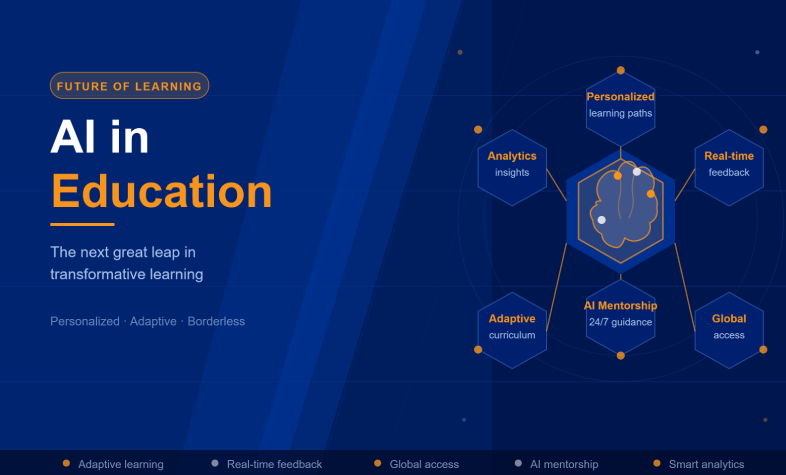
Personalized learning paths: It helps students in classrooms lacking a lot of facilities or resources to learn at their own pace, without the assistance of a teacher. Students in villages or remote areas who lack access to good private tutors or coaching centers can receive academic assistance through this system at any time of the day or night (24/7).
Automated Grading: It helps teachers with many students give good feedback without getting overwhelmed.
Language Translation: It helps make content available in a student's language which is important for reaching people all over the world.
Accessibility for Learners: It helps students with disabilities like visual, hearing or learning problems access the same materials as their friends.
Immediate Homework Help: It supports students who are learning on their own when no parent or teacher is around to help.
Scalable Teacher Support: It helps one teacher manage a classroom with students of different ages in areas with not enough money.
Data-Driven insights: It finds students who are having trouble even if they are in remote areas where teachers cannot check in often.
Workforce learning: It offers training to adults everywhere especially in areas where there are not many educational opportunities.
Education is always changing with ideas. We went from writing things by hand to printing books, from using chalkboards to having projectors in the classroom. Each time something new came along it changed how we share information. Artificial Intelligence is different from what we had before. It does not just give us information, Artificial Intelligence can look at things, answer questions, change and talk to us.
In education Artificial Intelligence is about computer systems that can do things that normally require intelligence. These things include understanding what someone is asking, seeing how someone learns, giving feedback and helping with problems. These systems make learning fun, easier and available to everyone.
Artificial Intelligence does not replace teachers, rather it helps teachers and students. Artificial intelligence assists students who face trouble learning and also helps teachers with their research and work. It makes it possible for learning to be tailored according to each student. As the world changes fast, AI in education is needed to transform simple education into modern education.
Artificial Intelligence in education is really changing the way we learn. It does a lot more than just give us answers or tell us things. Artificial Intelligence is making a difference in many areas of education today. For example, it is making online learning better. Giving students help when they need it right away. Artificial Intelligence is also helping people who speak different languages learn together.
A teenager in Mumbai can watch a science lecture that was recorded in London. A university student in Brazil can go over a lesson that was made in Japan. They do not have to get on a plane or go to a classroom or even meet the teacher in person. They are still learning from some of the best things that the world has to offer for education. This is what Online Learning with AI has made possible.
AI makes Online Learning better by making it more helpful and responsive. Online Learning with AI can suggest lessons based on how a learner is doing. It can also suggest things to help when someone is having trouble. Online Learning with AI can even make the learning go faster or slower depending on what each person needs. By just giving people information, Online Learning with AI helps make a place to learn that really responds to each student. So education is getting more flexible and easier to get to and more connected everywhere in the world. Online Learning with AI is really changing the way people learn.
Assessment is not about looking at marks at the end of a test anymore. AI in education is really helping teachers see how well students are doing in a way with the help of smart assessment and examination tools. These systems can grade answers that have one right or wrong answer all by themselves. They can also look at how students learn and find out where students might need a little help. A lot of learning platforms and digital classrooms are now using assessment tools that use AI to give feedback right away. This helps students see what they did wrong and get faster. AI in education is making a difference, with these smart assessment and examination tools.
The role of AI is big in company training. It is not just for schools and universities. Companies are using AI to help workers learn things. AI systems check what each worker needs to learn. Then they suggest courses that are just right. The systems also keep track of how workers are doing. They even recommend training if needed. Many companies use AI to help workers get better at their jobs. This way workers can learn about technologies. It makes learning at work easy. Companies do this to help their workers stay updated. Workers can learn skills with AI. It makes training fun and not boring.
One of the interesting things about AI in education is AI tutoring platforms. These systems work like a tutor. They guide students through lessons and answer questions. They explain concepts and provide practice exercises when needed. Unlike tutoring, learners can get help anytime. This makes learning more flexible and personal. Students from different locations and backgrounds can use these tools. AI tutors make it possible for students to learn at their pace.
Education is getting better for kids with disabilities and special needs because of intelligence. Artificial intelligence is helping with things like software that turns what you say into text and machines that read text out loud. Artificial intelligence is also helping with personalized learning systems and tools that assist with communication. These things are really helping students to learn in their ways. Some of the key benefits are mentioned below:-
Improved Accessibility : The thing AI does for education is make learning easier for everyone. AI helps students who struggle with seeing, hearing or learning. It makes online and regular school more friendly to everyone. Students with disabilities and special needs use AI to learn in their way.
Personalized Assistance: AI makes lessons fit each student's needs. Students with disabilities and Special needs get help that's just right for them. New AI tools give students exercises that're perfect for them and explanations that are easy to get. Students with disabilities and special needs learn at their speed and feel more confident with AI.
Assistive Technologies: Many companies that make AI for schools add cool features. These include talking to text, text to talking and live captions. These features help students join in more in class and online lessons. Students with Disabilities and Special Needs use these tools to learn.
Greater Inclusion: More people use AI for school and online learning. This means Students with Disabilities and Special Needs learn on their own. AI helps remove barriers and makes sure everyone joins in. This is great for Students with disabilities and special needs because it helps them learn like everyone.
Not every time you try to learn something is it because you have a test. Sometimes you just have a page and you do not know what to write. Maybe you have a research topic that is really confusing. You might have a presentation that's due tomorrow and you are not ready. Or you are trying to remember a chapter and it is just not staying in your memory. This is where AI tools for students are really helpful. These tools do not just give you the answers but they help you organize your ideas and make complicated things simpler. It is becoming more fun as it can be tailored according to each person. It is also easier for people to learn. When you use AI tools for students in a way you can save time, then you can focus on understanding things, figuring out what they mean and making new things. AI tools for students help with their progress.
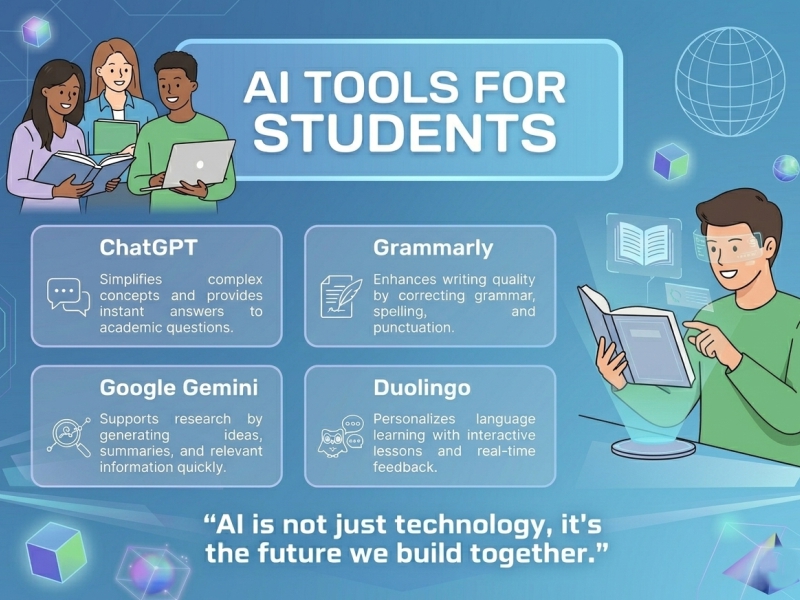
Explore the role of ChatGPT in AI-powered content creation, its impact on education, and future possibilities.
1. Perplexity AI: Perplexity AI is a digital assistant that conducts research on the internet on your behalf and provides proof that its information is 100% accurate. This allows you to easily verify whether the information is accurate or incorrect.
2. Elicit: It is primarily designed for finding extensive research papers. It generates concise summaries of the key points from complex research studies. It helps you quickly locate the specific paper needed for your assignment.
3. Notion AI: Notion is a highly modern digital notebook or diary that can be used on a computer or mobile device. Notion AI, on the other hand, is a highly intelligent personal assistant built right into that notebook. It keeps your digital notebook as tidy and organized as a well-arranged study desk.
4. Otter AI: When a teacher delivers a lecture in class, keeping this tool active automatically converts their spoken words into text. Later, you can easily locate the specific material you need by searching for any word within that text.
5. Consensus: Unlike standard Google, which retrieves information from any website on the internet, this tool finds accurate, evidence-based answers exclusively from major academic or scientific research papers. It is the best tool for obtaining accurate and well-reasoned answers regarding science or any other subject.
6. SciSpace: It can translate the difficult and complex language of research papers into very simple, plain language to make them easier to understand. It helps you understand complex scientific theories or technical texts that might otherwise be difficult to grasp.
7. Gamma: It instantly creates impressive presentations (PPT), documents, or beautiful visual content from your ideas or text. You do not have to waste hours creating slides.
When you use intelligence every day it is really important to use these artificial intelligence tools in a responsible and safe way. These technologies are very useful because they make things easy for you, help you learn in a way that's just right for you and give you fast access to the information you need. However, they also process a lot of your personal data. So one should know about the privacy and security rules before you share your information with platforms that use artificial intelligence. If you understand these rules you can enjoy all the things about artificial intelligence while keeping your digital identity and personal data safe.
Do not share personal information like your passwords, banking details, addresses or identification numbers with artificial intelligence platforms.
Only use intelligence platforms that you trust and that clearly tell you how they collect and store your data.
Take the time to read the privacy policies so you know how your information will be used by these intelligence platforms.
Create unique passwords for your artificial intelligence accounts and services.
Turn on two-factor authentication whenever you can because it gives you security for your artificial intelligence accounts.
One of the biggest problems with learning is not that there is not enough information; rather , everyone has a hard time finding the right information when needed . A lot of students open textbooks, wanting to learn but they end up feeling overwhelmed by all the words and the pages. Sometimes it's not just we are not trying rather, it's more like we just don't know where to start from.
E-Learning and artificial intelligence are changing the way we learn in some cool ways. As we know, artificial intelligence helps make learning feel more personal , hence artificial intelligence creates a learning path that is just right for each person or student. If a student is having trouble with something, they can get help and learn quickly and can move on without waiting. Learning is not about keeping up with the class, it's about learning at your own pace with E- learning and artificial intelligence.
The best thing about E- learning and artificial intelligence is that it gets to know the student. It remembers what we have learnt and finds out what we are bad at. It also suggests things that can help us and makes online lessons more fun and interactive. What used to be just a screen with information is now a place where we can explore and learn. Artificial intelligence is making online learning more fun. E- learning with artificial intelligence is not a different way to learn. It's a smarter way to learn.
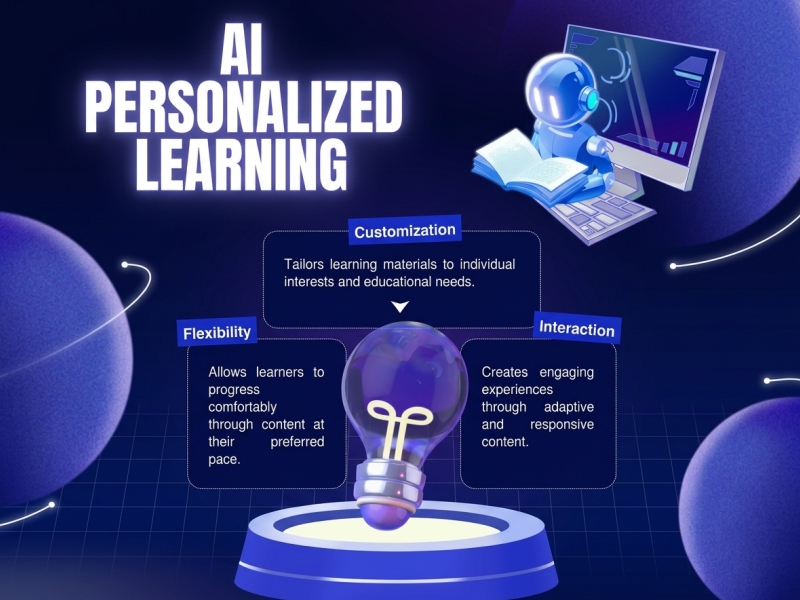
Education works best when it realizes people learn in different ways. Some people get ideas better from images and videos. Others learn more from talking, doing things themselves or seeing real-life examples. AI- personalized learning helps with this. It changes lessons and materials to fit each student's interests, strengths and learning style. So instead of making everyone follow the same path, it creates a learning experience that feels more personal and comfortable. This helps students learn at their pace in a way that suits them best. It makes education more effective and enjoyable. That is why AI- personalized learning is becoming a part of modern education. The education system benefits when it uses AI- personalized learning. It makes learning fun and effective for students. The approach helps students understand and use their knowledge better. AI-powered personalized learning is changing the way we think about education.
The biggest revolution in education is not that people can learn more- it is that people can keep learning all their life.
For a long time education was connected to a specific place, a specific age and specific stage of life. People went to school and university to get their degrees and then started working. Now these boundaries are disappearing very fast. In a world where new things are being invented all the time, learning has become something people need to do all their life, not just when they are young.
Explore the Top 15 Institutes for B.Tech in Artificial Intelligence(AI) in India.
Imagine a software engineer who wants to learn a programming language, a doctor who wants to know about the latest medical discoveries, an entrepreneur who wants to understand what is happening in the market or a retired person who wants to learn about astronomy just for curiosity, EdTech and AI are making it possible for these people to learn new things to get knowledge from anywhere not only from schools and universities.
Learning at the Speed of Change
The world is changing fast. New technologies, new industries and new careers are appearing all the time. EdTech and AI are helping people learn skills all the time so they can keep up with the changes.
From Information to Insight
It is not hard to get information, the harder part is understanding what it means. Every day thousands of articles, research papers and reports are written. EdTech and AI are helping people make sense of all this information by summarizing it, finding patterns and pointing out the important things.
Democratizing Expertise
In the past it was not easy to get advice from experts. You had to be in the place or have enough money. Now EdTech and AI are making it possible for people to get high-quality educational resources from anywhere. Knowledge that was only available to a people is now available to anyone who wants to learn.
A curious fact about this modern world is that learning usually starts with a question. This could be a student asking why the sky turns pink and orange when the sun sets or a researcher looking for patterns in a file of data or a professional trying to figure out how a new technology works. The question is always different but the way we go about finding the answer is pretty much the same - we search, we explore, we learn.
This is where AI education platforms come in. It isn't like big digital libraries with too much information; rather they are like smart guides that help us navigate through all the things we can learn. They show us where to find the information and make hard ideas easier to understand and help us connect with ideas that we might not have thought of before.
More Than Information : AI education platforms do not just give us answers. They help us turn information into something that is understandable.
From Search, to Discovery: Everyone does not have time to spend hours looking for a book or website. AI education platforms help us find what we need so we can focus on learning rather than searching.
Connecting Knowledge: AI platforms can bring together ideas from subjects, which helps us think more broadly about different things
Supporting Lifelong Curiosity: No matter how old we are, AI education platforms make it easy to change our curiosity into understanding in this changing world.
In ways AI education platforms are not just changing the way we learn. They are changing the way we think about knowledge and AI education platforms themselves.
There was a time when knowledge had an address. This knowledge was found on bookshelves in libraries, in classrooms and in textbooks. To get information, one often had to travel to where this knowledge was kept. Now knowledge is everywhere as it moves across computer screens, phones and the internet reaching people wherever they are.
Digital education is a change. It is not about taking books and turning them into PDFs or taking lectures and turning them into videos. Digital education is about changing the way we make, share and use knowledge. We can use fun and interactive things, work together online, use pictures and videos and use computer programs to help us learn. All these things make learning fun and exciting.
The best thing about education is that it makes learning a part of our daily lives. Knowledge is not something no longer people visit occasionally; it is something they can carry with them, explore continuously, and access whenever curiosity arises.
An interesting fact about knowledge is it does not have borders. If you ask a question in a small town, someone on the other side of the world might have the answer. For a long time, distance determined who could learn what. Libraries and universities were usually in specific places not giving everyone the same chance to learn.
Now the reality is changing. For example, a young person who loves animals can read about conservation studies, published by researchers far away, a person who owns a business can learn about marketing from experts in other countries, someone who loves history can look at documents of another country. None of them are travelling, yet all of them are crossing borders through learning.
What is really great about this change is that people can now find opportunities that they might not have found before. There are tools that can translate languages, websites that help people learn and search systems that're very intelligent. These tools are helping people discover ideas that they might not have known about otherwise. So Global Education Access is not about helping people find information. It is about helping people find new possibilities. Global Education Access is about connecting people to opportunities through learning. Global Education Access is making it possible for people to learn from others around the world.
1. Reach: Now students who live far away can learn from the internet with the help of Artificial Intelligence. They can get educational resources that they could not get before.
2. Personalized Education: Artificial Intelligence helps students learn in their way. It sees what each student is good at and what they need help with.
3. Affordable Learning: Learning on the internet and using Artificial Intelligence for education is cheaper. It saves money that people used to spend on education.
4. Inclusive Education: Artificial Intelligence in education helps students who're different. It lets them learn in their way and participate more.
5. Global Connectivity: Now students can learn from schools and experts around the world. This is because Artificial Intelligence is making education available everywhere.
1. Internet Limitations: Some places do not have the internet. This means students who live there cannot use the internet to learn with Artificial Intelligence.
2. Device Availability: Not all students have computers or phones. They need these things to use Artificial Intelligence for learning.
3. Digital Literacy: Students and teachers need to learn how to use Artificial Intelligence and other educational tools. This can be hard for them.
4. Data Privacy: When we use Artificial Intelligence we have to be careful with information. We do not want to get it over our hands.
5. Unequal Implementation: Artificial Intelligence in education is getting better fast. Some countries and schools are not using it as much as others. This is not fair. The Digital Divide is still a problem because of this. Artificial Intelligence can help bridge the Digital Divide. It is not being used equally everywhere.
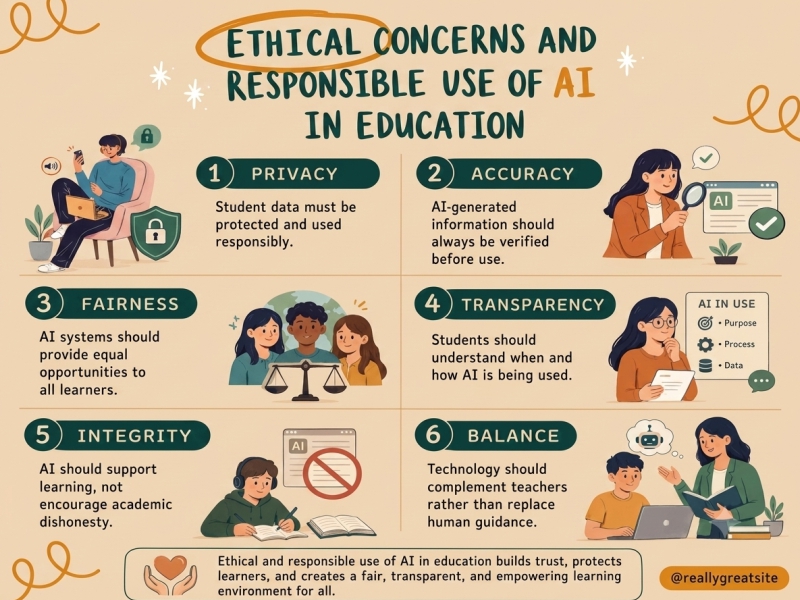
Education is something that people have always wanted to do because they are curious and they want to learn things. The thing about Artificial Intelligence is that it is changing the way we learn things and making it easier for people to get the information they need. It is making it possible for people to learn in their own way at any time in their life. Artificial Intelligence can give people information and help them learn but the things that make us human like is being creative, thinking carefully about things and being curious as that is still the most important part of education. If we use Artificial Intelligence in a way it can help us make a future. Where education is fair for everyone, where learning is fun and where everyone has the chance to do great things.
The future trends of Artificial Intelligence in education is not about smarter technology, it is about creating learning experiences that feel more personal, accessible and engaging for every single student. Artificial Intelligence is expected to move beyond answering questions in the coming years and become a learning companion that understands the strengths of every student, identifies areas where every student needs improvement and adapts lessons accordingly for every student. There are things that can help make quality education available to learners. These include virtual tutors, immersive learning environments and real-time feedback systems and these can help make quality education available to learners regardless of the location of every student or the background of every student. As Artificial Intelligence technology continues to evolve the goal will not be to replace the teachers but to empower the teachers with tools that make learning more meaningful, inclusive and effective for every student.
To further advance academic excellence, IIRF has expanded its reach through diverse initiatives, including ICOSA for school accreditation, study abroad programs, and specialized online courses.