To further advance academic excellence, IIRF has expanded its reach through diverse initiatives, including ICOSA for school accreditation, study abroad programs, and specialized online courses.
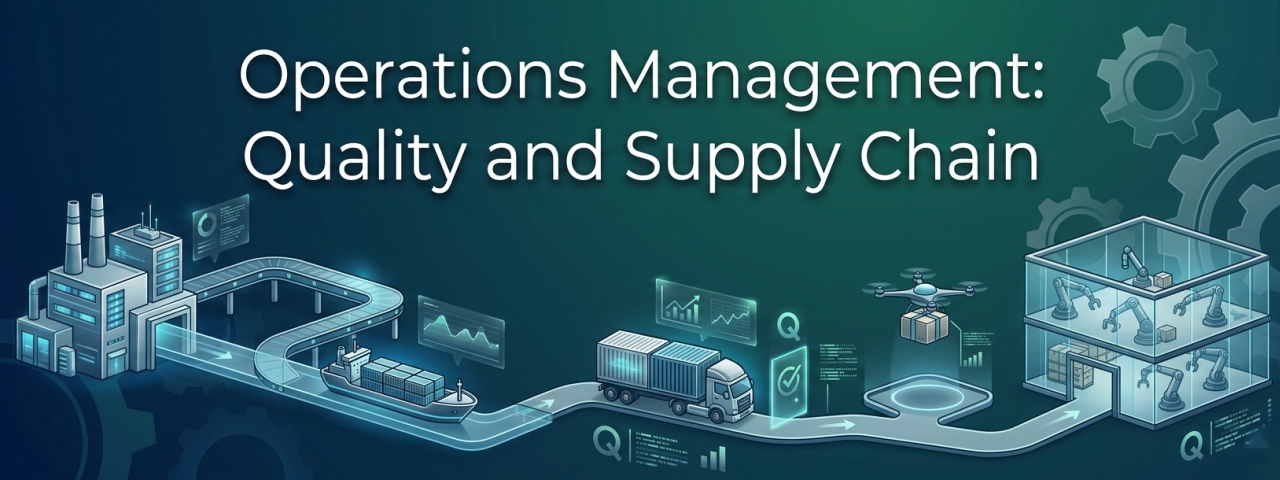
Operations Management is one of the most lucrative niches within all of Business Management for a very simple reason. Mastering Logistics and Quality Control processes means that a professional can operate across borders and increase profitability of a company almost instantly.
This ability to make turnarounds happen in short amounts of time allow such experts to dictate their salaries, and make Operations Managers some of the most respected and highly paid professionals out there.
If you want to empower your career with the power of quality and supply chain, this course is your chance. Learn more about its unique insights on production strategy here!
The Quality Control and Quality Assurance (QA and QC) portions of the Operations Management course are 100% practically focused. For example, they do not merely contain definitions of various quality standards and compliance rules, though these are also included as reference material. Instead, they use interactive assignments to make dull theory more interesting, while building detailed practical exercises to help learners understand the nuances of crucial practices such as Six Sigma and quality audits.
The aim with every module within the Operations Management course is to allow learners to immediately implement what they have just learned. The rule which the experts who created the course followed at every step was: if we use it in our professional lives as senior Logistics and Quality industry leaders, it should be in the course. Else, it has no place. This is reflected in the fact that the course length is highly optimized, with no fluff.
The certificate that is issued to all learners who successfully complete the course is directly linked to career growth. It can be included within the core set of documents that are submitted while applying to jobs in the field; it can also be uploaded to LinkedIn. The keywords that capture the lessons completed within the course are optimized according to the search queries that are used by senior Human Resources professionals within the logistics and supply chain management sectors, further increasing the probability that learners who complete the course will receive inbound job interview invitations in addition to their outbound applications to jobs across the world.
The curriculum for the Operations Management course is crafted to be relevant to learners in all geographies. Logistics and Quality Assurance are uniquely international disciplines; it is impossible to learn the regulations and best practices only for one country and still be successful. Therefore, the course curriculum creates professionals who can work across borders, who can make complex procurement calculations using data from different markets to arrive at the most optimal answer. This in turn drives down costs and drives greater productivity, showing why qualified Logistics Experts are so crucial for a company’s success.
The most challenging portions of the Supply Chain Training course are those which deal with quality standards and regulatory compliance in multiple countries; this is even more difficult when planning the journey of a shipment that has to pass customs inspections in more than one port. The systematic method of teaching within the course and the emphasis on sound understanding of basic principles works well in this regard, and learners will find that even problems which seemed almost impossible initially have logical solutions that make sense when implemented step by step.
At the same time, it is also important that learners are clear on which regulations to comply with; in the Operations Management space, new laws can be passed on a daily basis, and understanding their implications on calculations and shipping rates can make or break a project’s profitability. This course helps with that as well, by providing reference material which is constantly checked and updated.
It also teaches learners how to find the latest regulations for their geography of choice, and empowers them to make the most relevant calculations at the right time, using the most credible sources. The aim is always to communicate the logic behind logistics decisions, so that learners will be able to implement them in situations where millions of dollars could be saved if a cheaper alternative with the same quality is found.
The assignments are 100% in line with the most stringent global standards. The Quality Management course does everything possible to ensure that learners do not make mistakes when they apply the lessons included within the Professional Certification in a real life project. To this end, the assignments slowly slope up in difficulty until the last few are even more complex than situations normally encountered in a Supply Chain Management scenario. This helps learners build up the confidence required to implement everything that they have learned, and the course treats every error and small failure as a learning opportunity. Each assignment is followed by a detailed solution and feedback, so that learners can find out where they went wrong, and reduce the number of mistakes they make in a practical implementation scenario.
There is a clear hierarchy of preference levels and average salaries within the world of business, engineering, and management. Operations Managers are up there on both axes, along with the most senior CXO Level leaders and external management consultants. But what makes them so sought after, and why do businesses not rest until they find the perfect set of professionals to run their supply chain and logistics departments?
This is primarily because the skill of analyzing very complex large scale processes, identifying the root causes of all the issues in those processes, and then designing solutions to fix those issues is a very rare one, and only a few in every million people possess it. The good news is that the skull can be acquired in a short amount of time through a smart study mechanism such as the Logistics Operations course.
The career benefits of this course are, first and foremost, to unlock senior jobs and career opportunities linked to higher pay packages. Here is how the course works to optimize employability:
First, it teaches abilities that are central to the skill of operations management, but that are often ignored in textbooks and other courses. For example, the skill of estimating numbers and making quick calculations is one that is very important in high pressure logistics situations, and the Supply Chain Training course teaches this in multiple ways; the skill is built into every module.
In addition, the course breaks down logistics into its logical components. Shipping and procurement are very clear mathematical concepts, but many other courses complicate these simple things by adding details that are not necessary. The course frames problems within the supply chain sector as being optimization balances between different forces, and thereby makes the logic very clear.
The course is also integrated with technology tools that help make accurate calculations more quickly, and others that are used in real life companies to manage projects related to Operations Management.
The main advantage of the course for supply chain professionals is its immersion in the world of quality and logistics management. Candidates who appear for operations management sector interviews after completing the course will not feel like they are doing anything new; everything asked to them will be familiar. This is the #1 rule of success in a job interview: that there should not be the fear of the unknown.
The Operations Management course also puts efficiency and optimization front and center. The biggest advantage it confers on those who complete the course is to change their mindset to one which constantly looks at processes and thinks about how they could be better. This analytical mindset is very important for on-ground experts; they need to be able to make instant decisions about how to make small tweaks to large industrial processes or complex logistics roadmaps. And these decisions, if correct, can deliver huge cost savings. If they are wrong, they could torpedo an entire project. The Operations Management course ensures that the first of these options is what takes place.
In the modern world, it is important to achieve high quality Operations Management outcomes without a good understanding of data analysis. The course teaches learners the basics of extracting credible insights from big data sets; these insights then inform the big business decisions that will determine logistics shipping routes, supply chain vendor choices, and even quality standards across the organization. One of the biggest advantages of the course is its ability to deliver important lessons from peripherally related disciplines like Data Analysis and point out their relevance to Operations Management.
By the end of the course, the learner will be able to use all the new skills acquired at the same time to solve Operations Management problems. It is as important to use the right skill for the right job as to learn the skills. For example, making a quick approximate vendor decision based on instinct is sometimes the right call, as compared to a detailed cost benefit analysis that would take too long to complete. These repeated assignments allow learners to become true experts by using the course, gradually improving their instincts and producing output that is reliable every single time.
This Quality Management course will be of the most use to learners who understand their level of skill and interest in every dimension that make up a strong supply chain professional. This can be gauged through the initial few topics covered by the course, but it is ideal for a new learner to assess their own estimation, logistics, international supply chain, and optimization skills beforehand so that they can concentrate extra hard on those modules which deal with these topics. The course then becomes a tool to polish the skills that are weakest, and it can be used as a customized learning tool.
Learners must also ensure that they complete all the Logistics Operations assignments. This is especially crucial for those who are currently students or junior professionals looking to make it big in the field of Operations Management or Quality Management. Many of the assignments are lengthy, and will take several hours and a lot of effort to complete. But spending the time early in your career to master the basic concepts and fundamental processes will always pay off in the long run, when you see that complex logistics decisions become routine mental calculations for you.
The course provides a clear tracker of quizzes and assignments completed; you must ensure that each one also receives the level of care and quality management that you would apply to a major client project.
Making notes is an essential part of most courses, but this Operations Management course is so logically structured and optimized in length that you can use the study material as your own notes. However, it is still recommended to note down the main points for use in the real world; you can also use those highlighted details as anchors when you revisit the course material in future, perhaps to revise the basic concepts for a senior level promotion interview, or to brush up your understanding of Quality Management before a major global project kicks off. The material is always there for you to refer to, and it is also constantly updated to stay at the cutting edge of industry expectations from a senior Logistics Operations expert.
Finally, learners should also calculate their optimal speed of completion of the course, and give themselves a buffer of 10%-20% over and above this time. This allows for extra revision, implementation in live projects in the real world, and reflection on the lessons learned. After all, Supply Chain Management is one of those skills that, if learned properly the first time, never needs to be studied from scratch again; it is only about perfecting skills. On the other hand, if you don’t learn it at a slow and steady pace the first time, the errors in your basic understanding might make your concepts a major weakness throughout your time in the field. So take your time, but do it right.
If you have always wanted to find a Supply Chain Training course that will give you everything you need to access the most lucrative jobs in the field of Operations Management, your search is at an end. Sign up for the Quality Management Course today!
Course Link (Operations Management Course - Master Quality & Supply Chain Strategies): https://iirfranking.com/online-courses//course-details/operations-management-essential-training