
September 23rd, 2026
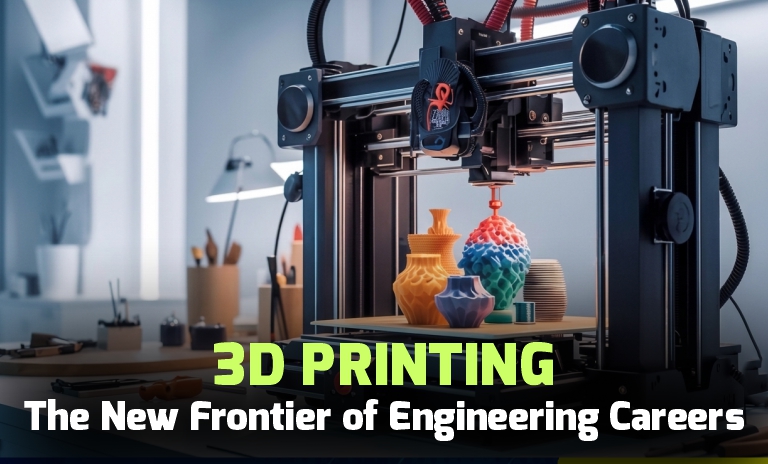
Envisage being told that one day, of cutting, drilling or assembling a machine part you could simply tell a printer to build it layer by layer. A year ago that probably sounded more like a futuristic-fiction idea than a career plan. Today someone has to plan those parts, opt the right materials, handle advanced printers and make sure the final product actually works. That person could be a printing engineer. It is one of those careers that most students did not grow up dreaming about because honestly it barely existed as a traditional career option. As manufacturing becomes more digital and flexible 3D printing is creating new roles for engineers who understand both machines and technology.
The shift is already visible across industries. Aerospace companies use 3D printing to create components, healthcare uses it for customised medical models and implants, while automobile manufacturers use it for prototypes, tools and specialised parts. India is also becoming a part of this growth with companies, startups, research institutions and educational institutes exploring additive manufacturing for everything from engineering prototypes to large-scale production. Globally the technology is moving beyond experimentation and becoming a practical part of modern manufacturing.
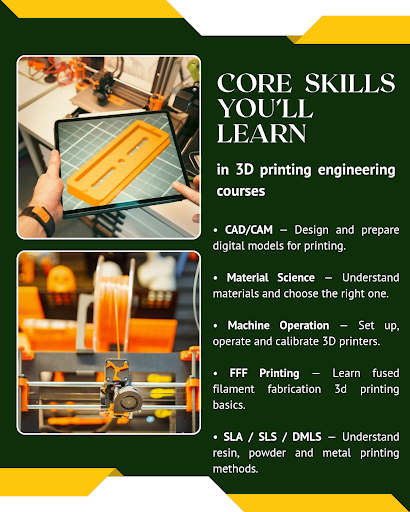
For students and working professionals this creates a question: what does it actually take to become a 3D printing engineer? Learning how a printer works is one part of the picture. You may need knowledge of CAD design, materials, production processes, automation, quality control and digital manufacturing. This is where a 3D printing course or a digital manufacturing course can help build the foundation needed to enter this growing field. Students looking for a career path can also explore specialised manufacturing engineering courses.
In this article we will look at what a career in printing engineering really looks like where these professionals can work, which skills employers are looking for and how the field is developing in India and abroad. We will also explore the types of courses students and professionals can consider, including printing course options, digital manufacturing course pathways and manufacturing engineering courses offered by institutions, in India and overseas. The goal is simple: to understand whether this emerging career could actually become your next big opportunity.
Conceptualize this: an automobile company needs a plastic component for a new car. In the past, making that one piece meant crafting a mould, sending it off for manufacturing, waiting weeks for the part and then finding out the design had a flaw. The whole process would start over again. Now imagine an engineer tweaking the design on a computer in the morning and having a version of the part ready to test within hours. That’s where a 3D printing engineer comes in. Their job is to take an idea that persists on a screen and help turn it into something actual—something you can hold, test, improve and eventually construct.
So what does a 3D printing engineer do every day? It’s not just pressing a button and waiting for a printer to finish. They spend a lot of time on the computer creating or adjusting a model. They decide which material will work best for the part—plastic, resin or something else. They set the printer’s temperature and print speed. Then they start the printing process and watch it run. After the print is done they inspect the part. If the part is too weak, uneven or slightly off, from the design they have to figure out why. One of the methods they use is called fused filament fabrication 3D printing. Put simply, "fused" means melted together, "filament" refers to the plastic wire used by the printer and "fabrication" means building something. The printer melts this plastic and lays it down in hundreds of thin layers until the entity is complete. It’s like watching someone build an object layer by layer—except the computer controls every move.
This is why the job is getting much attention right now. Companies don’t want to spend weeks. A lot of money making a prototype anymore. With printing they can test an idea quickly and efficiently. An aerospace company can try out a part. A car manufacturer can test a design in a matter of hours. A medical team can make a custom model of a patient’s organ before a surgery. As more industries begin using this method they need people who understand both engineering and digital technology. That’s why the role of a printing engineer is becoming more and more interesting. It’s not about the printing itself being new. It’s about how time, money and creativity is saved for businesses.
Think about how fast the way we make things has changed. A factory today doesn’t always need hundreds of workers doing the job over and over. Computers, robots, smart machines and digital designs are taking over parts of making things. This change is often called Industry 4.0—in words the move towards smarter, more connected manufacturing. 3D printing fits into this change because companies can take a digital design and turn it into a real product without always needing a lot of money for molds or long setups. As 3D printers have also become cheaper and easier to use, more businesses, colleges, startups and small workshops are trying them out.
India is also trying to build a manufacturing base and programs like Make in India have helped push this change. The idea is simple: make products in India instead of relying a lot on imports while pushing new technology and ideas. 3D printing can help with that—it lets companies make models quicker, try new ideas and make certain custom parts without building a big traditional production line. As this happens the need is not for expensive machines but also for people who know how to use them well. That is why 3D printing is slowly moving from being a " new technology" to becoming a real job opportunity, for engineers and students.
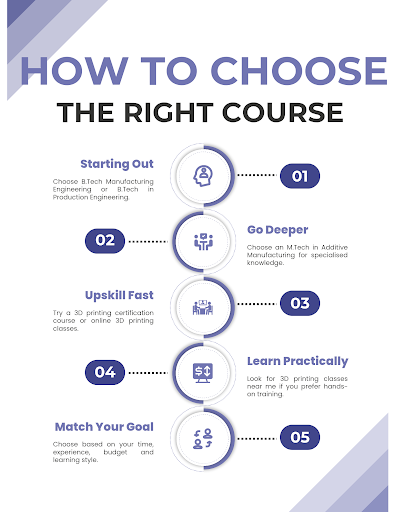
There is no degree that you must have to become a 3D printing engineer. You can enter the field through manufacturing or production engineering. Then add specialised 3D-printing skills. If you are already an engineer or working professional a short-term course or certification can also help you move into the field without starting from zero.
If you like the idea of understanding how a product goes from a computer screen to a factory floor, B.Tech Manufacturing Engineering can be a strong starting point. The course gives students an understanding of how products are designed, made, tested and improved. Modern manufacturing is also becoming increasingly digital so students may get exposure to areas connected with automation and additive manufacturing
Some of the areas students may study include:
The biggest advantage is that you learn the fundamentals behind manufacturing by learning only how to operate a 3D printer. Later you can add printing knowledge through projects, internships or specialised training. This combination can be useful because a professional needs to understand not how to print a part but also whether 3D printing is the right way to manufacture it.
Think about a company that needs to manufacture thousands of products without wasting time, material or money. A production engineer works around these kinds of problems. A B.Tech in Production Engineering focuses on how manufacturing systems work and how production can be made efficient while maintaining quality
Some of the areas students may study include:
This background can connect well with 3D printing because additive manufacturing is becoming another way of producing and testing parts. Students can later build knowledge in 3D printing through electives, projects, internships or certifications. It is particularly useful for someone who wants to understand the production side of manufacturing rather than focusing only on the printer itself.
For students who already have an engineering degree and want to go deeper into 3D printing, an M.Tech in Additive Manufacturing is a much more specialised option. Of treating 3D printing as just one topic these programmes can explore the technology, materials and design principles behind layer-by-layer manufacturing
Some of the areas students may study include:
One important part is learning how to design for 3D printing. A shape that is difficult or expensive to make using manufacturing may be much easier to print. Students therefore learn to think about materials, geometry, strength, printing time and production efficiency. This makes the programme a good choice for someone who wants technical knowledge rather than just basic printer training
A 3D printing certification course can be the easiest place to start if you are new to the technology. Of committing to another full degree you can learn the basic process—from creating a digital model to preparing it for printing and understanding why a print sometimes fails
A course may cover:
When choosing one, don't look only at the certificate. A course with assignments or access to a real printer is much more useful. Being able to design something, print it, find a problem and correct it gives you a much better understanding of the technology than simply watching videos.
Additive manufacturing courses generally go a little beyond beginner-level 3D printing. They explain the technology behind manufacturing objects layer by layer and may introduce students to different printing methods, materials and industrial applications
Depending on the level these courses may cover:
The useful part is that you begin to understand when 3D printing actually makes sense. For example a company may use it for a prototype, a customized component or a complex design. Traditional manufacturing may still be better for some large-scale products. Understanding this difference is what turns printing knowledge into practical manufacturing knowledge
A 3D printing technology course focuses more closely on how the technology and machines work. It can be useful if you want to understand what is happening behind the printer settings of simply pressing "print" and hoping everything goes well
Common areas may include:
This kind of training becomes particularly useful when something goes wrong. Maybe the layers are not sticking to the print. The finished object is weaker than expected. By treating it as a random printer failure you learn to identify the likely cause and adjust the process. That practical problem-solving ability is one of the valuable things to develop.
For students who cannot regularly visit a laboratory or training centre online 3D printing classes offer a flexible way to learn. They can cover the theory, design software and digital side of 3D printing allowing learners to study around college or work schedules
Online courses may include:
However online learning has one limitation: you may not get experience with an actual machine. So before enrolling check whether the course includes projects, demonstrations or any form of hands-on training. Ideally use learning to build your knowledge and then get some real printing experience through a college lab, workshop or makerspace
| Course Type | Duration | Best For | Mode | Fees |
| B.Tech in Manufacturing Engineering | 4 years | Fresh graduates | Offline | Govt: ₹4,000 – ₹1.5 Lakhs Pvt: ₹2 Lakhs – ₹20 Lakhs |
| B.Tech in Production Engineering | 4 years | Students into production systems | Offline | Govt: ₹4,000 – ₹2 Lakhs Pvt: ₹2 Lakhs – ₹16 Lakhs |
| M.Tech in Additive Manufacturing | 2 years | Specialization/R&D seekers | Offline/Hybrid | Govt/IITs/NITs: ₹48,000 – ₹1.5 Lakhs Pvt/Univ: ₹1.3 Lakhs – ₹2.8 Lakhs |
| 3D Printing Certification Course | 3–6 months | Career switchers, professionals | Online/Offline | ₹5,000 – ₹35,000 (Short professional bootcamps) |
| Digital Manufacturing Course | 3–12 months | Industry 4.0 entrants | Online/Hybrid | ₹50,000 – ₹1,50,000 (Executive/PG certificates range up to ₹1.1 Lakhs – ₹2 Lakhs) |
| Online 3D Printing Classes | Self-paced | Beginners, hobbyists | Online | Free to ₹500 – ₹2,600 per hour via platforms like Superprof 3D Printing Classes or subscription tiers (Skillshare/Outschool) |
India’s 3D printing and additive manufacturing space is growing quickly. Students now have choices than just learning from a basic 3D printer workshop. IITs, NITs and specialised private institutes offer programmes that span engineering degrees to short‑term certification courses. This lets you pick a path that fits where you are in your education of following the same route as everyone else.
If you want a full academic foundation, a manufacturing or production engineering degree can be a start. Graduates and working professionals may prefer an additive manufacturing or 3D printing certification. The table below compares some of the options in India showing what they offer and who they suit best so you can more easily pick a course that fits your goals.
| Course | Institute/University | Level | Fees and duration |
| B.Tech Manufacturing Engineering | IIT Delhi / NIT Trichy | UG | ₹5.0 lakhs – ₹11.3 lakhs (4-year total) |
| B.Tech Production Engineering | Jadavpur University / VJTI Mumbai | UG | ₹6,000 – ₹6.7 lakhs (4-year total) |
| M.Tech Additive Manufacturing | IIT Hyderabad / IIT Kanpur (relevant specialization) | PG | ₹1.0 lakh – ₹2.5 lakhs (2-year total) |
| 3D Printing Certification Course | Skill-India / NIFT / private ed-tech platforms | Certification | ₹5,000 – ₹60,000 (per course) |
| Digital Manufacturing Course | CII/industry-affiliated institutes | Certification | ₹15,000 – ₹75,000 (per course) |
| 3D Printing Classes Near Me | Local polytechnics, Fab Labs, Makerspaces | Short-term/local | ₹2,000 – ₹15,000 (per workshop) |
If you want to take your 3D printing learning beyond India, there are plenty of interesting options around the world. Universities in the US, UK, Germany and Singapore are doing state-of-the-art work in additive manufacturing, so students can reveal everything from specialised degrees to industry-focused programmes and online 3D printing classes.
The right international course depends on what you want—deep research, direct manufacturing experience, or simply a stronger understanding of the technology. The table below highlights some important global options to help you compare them without getting lost in the crowd of course listings.
| Course | University/Platform | Country | Fees |
| MS in Additive Manufacturing | Penn State University | USA | $35,000 – $50,000 |
| MSc Additive Manufacturing | University of Nottingham | UK | $17,000 – $43,000 |
| Additive Manufacturing Certificate | RWTH Aachen University | Germany | $370 – $2,500 |
| Online 3D Printing Specialization | Coursera (offered by University of Illinois) | Global/Online | $49 – $79 per month |
| 3D Printing Technology Course | edX / MIT xPRO | Global/Online | $2,469 for the professional course |
| Digital Manufacturing & Design Course | Coursera (University at Buffalo) | Global/Online | $49 per month |
A career in 3D printing does not always mean devoting excessive hours at a printer. As you gain experience your job can shift from running machines to designing products, improving how things are made, fixing technical issues and in the end leading teams. The path people take can be different. It usually follows a pattern: starting with hands-on tasks → taking on technical work → making big decisions and leading projects.
In the beginning your job will be very practical. You might devote time learning how the machines operate, getting digital files ready, checking printed parts and figuring out why a print works or fails. This stage is about becoming familiar with both the software and the real-world side of printing.
Common entry-level roles include:
3D Printing Technician- Operates printers, prepares files and inspects parts.
CAD Design Engineer- Builds and adjusts 3D models that become physical items.
Prototype Assistant- Helps turn product ideas into working test models.
Junior Manufacturing Engineer- Assists production and learns how digital manufacturing operates.
Once you have some experience your role changes. It’s no longer about using the machine. You start solving manufacturing problems. You may choose materials, adjust print settings, reduce defects or find ways to make a part. You could also work with designers, production staff and quality teams.
Common mid-level roles include:
Additive Manufacturing Engineer- Designs, Improves 3D-printing methods.
Process Engineer- Finds ways to make manufacturing faster and more reliable.
Quality Engineer- Makes sure printed parts meet standards.
Production Engineer- Helps manage the manufacturing flow.
At the level the focus turns from "How do we print this?" to questions like "Should we print it this way?" or "How can this technology improve everything?" Experts at this stage may lead research, guide companies develop materials or decide which technologies to use in production.
Possible senior-level roles include:
R&D Lead- Leads research and creates products or printing techniques.
Manufacturing Consultant – Advises companies on choosing and improving manufacturing systems.
Materials Specialist – Studies materials and their performance in 3D printing.
Technical Lead – Guides engineering, Handles large-scale projects.
The best thing about this career is that you don’t have to stay in one place. Someone who begins by running a printer can slowly move into design, process engineering, research, materials science or even management as they grow in knowledge and experience.
| Level | Typical Roles | Key Responsibilities |
| Entry | 3D Printing Technician, Junior CAD Engineer | Machine operation, basic design support |
| Mid | Additive Manufacturing Engineer, Process Engineer | Process optimization, material selection |
| Senior | R&D Lead, Manufacturing Consultant | Strategy, innovation, cross-functional leadership |
1. What do you learn in a 3D printing course?
A 3D printing course teaches you how an idea on a computer becomes an object. Depending on the course you may learn CAD design, slicing, printer operation, materials, settings and basic troubleshooting.
2. Is Production Engineering the same as Manufacturing Engineering?
Not exactly. They overlap in areas but Manufacturing Engineering focuses more on how products are designed and made while Production Engineering gives more attention to managing and improving the overall production process.
3. What can you do after an M.Tech in Additive Manufacturing?
It can open doors to roles in additive manufacturing, product development, research, process engineering and advanced manufacturing. It can also be useful if you want to move into R&D or level technical work.
4. Do online 3D printing classes have value outside India?
Yes, especially when the course comes from a university, institute or industry platform. However practical experience matters too so an online course with projects and hands-on components can be more useful than a certificate
5. What is FFF 3D printing actually used for?
Fused filament fabrication 3D printing is commonly used for prototypes, educational models, product testing, customised parts and small-scale manufacturing. It is popular because the machines and materials can be relatively accessible.
6. How do I choose 3D printing classes near me?
Don't look at the certificate. Look if the class gives you access to a printer, CAD or slicing software, practical projects and troubleshooting experience. A little hands-on practice can make a difference.
7. What kind of jobs can manufacturing engineering graduates get?
Manufacturing engineering graduates can depend on roles such as manufacturing engineer, production engineer, process engineer, quality engineer or additive manufacturing engineer. The opportunities vary between India and global markets depending on your skills, experience and specialisation.
The exciting thing about 3D printing engineering is that it is still being shaped right now. There is no path that says you have to follow only one route or work in only one type of industry. From a student learning how to create their 3D model to an engineer developing parts for cars, medical equipment or aircraft there is plenty of room to learn, experiment and grow. That makes this field especially interesting for students who do not want a career that feels repetitive.
The good news is that you do not have to know everything from day one. You can start with a manufacturing course, explore a 3D printing technology course or build a strong foundation through a B.Tech Manufacturing Engineering degree. As your interest grows you can move towards areas such as additive manufacturing, advanced materials, product design or research. The important thing is to start and keep building your skills.
A year from now 3D printing may be as normal, in some industries as computers are today. The students who start understanding it could be the ones designing, improving and using the technology in ways we have not even thought of yet. So if you are looking for a career where engineering meets creativity and new ideas this could be the time to take that first step. The future of manufacturing is being built one layer at a time—. You could be one of the people building it.
To further advance academic excellence, IIRF has expanded its reach through diverse initiatives, including ICOSA for school accreditation, study abroad programs, and specialized online courses.