September 2nd, 2026
One small mistake online can sometimes open the door to a bigger problem.
Ideate checking a bank account and discovering that some money is gone. No one in the family knows how it happened. Then comes the shock. Someone has accessed the account online. Tales like this are becoming more common as people do more things over the internet.
In the current epoch almost everything is done online. Students attend classes from home, parents pay bills through apps and people shop online. Workers send important files using smartphones and computers. With all this convenience comes a risk. Personal details, passwords, photos and money can be in danger if they are not protected properly.
The numbers make it clear why cybersecurity is a must see field to go for. In 2025 India alone had more than 4 hundred cybersecurity product companies. These companies together earned 4.46 billions of US dollars. Around the world the need for cybersecurity professionals is still much greater than the number of people available. In 2024 there was a gap of 4.8 million workers in this area. The World Economic Forum also lists networks and cybersecurity as among the growing skills for the years 2025, to 2030. (Source: DSCI, ISC2 World Economic Forum)
That is why cybersecurity is growing its importance. It helps keep people, businesses and their data safe from threats. It’s also becoming a career choice. This article will cover everything that students need to know about cybersecurity and its career options. It will look at cybersecurity courses after 12th, eligibility, different degree options, B Tech Cybersecurity, MTech in Cyber Security, MSc Cyber Security, Master of Science in Cybersecurity and other courses that can help students build a career in this field. It will also explain the skills, career choices and opportunities available in cybersecurity.
Every day we leave pieces of our information on the internet. We enter passwords, share phone numbers, make payments, send documents and save photos and files. Cybersecurity is the way of keeping all these things protected. It includes the tools, rules and precaution steps used to stop someone from entering a device, account, website or network without permission. It also helps protect information from being plagiarised , changed or damaged.
For example imagine receiving a message that says, "Your bank account needs an update. Click here." It looks normal so the link is opened and the details are entered. A minute later the person may realise that the message was factitious. This is called phishing, where someone uses a message or website to fool people into giving away their information. Cybersecurity helps block such threats and also teach people how to shun them.
The importance of cybersecurity has grown because the internet has become a part of life. College work, office work, shopping, banking, hospital records, business information and personal conversations are now handled online. This has made things faster and easier. It has also created more chances for online attacks. That is why cybersecurity is no longer something only large companies or computer experts ought to fret over. Anyone who uses a phone, computer or the internet has a reason to understand cybersecurity.
After finishing Class 12 students who like computers, technology and online safety have options for cybersecurity courses. Some can start with a bachelor’s degree while others can study cybersecurity at the master’s level later. The best course depends on whether a student wants to focus on technical work, research or business and management.
A B.Tech in Cyber Security is a choice for students who want to learn cybersecurity from the start of their college years. The course usually covers areas such as network safety, ethical hacking, digital forensics, coding and data protection.
Institute | Course | Main Focus | Location |
IIT Kanpur | B.Cyber | Cybersecurity | Kanpur |
JIET | B.Tech Cyber Security | Cyber Defence | Jodhpur |
UPES | B.Tech CSE | Cyber + Forensics | Dehradun |
Amity University | B.Tech CSE | Cyber + Blockchain | Kolkata |
VIT | B.Tech CSE – Cyber Security | Cyber Security | Vellore, Tamil Nadu |
SRM University | B.Tech Cyber Security | Cyber Security | Amaravati, Andhra Pradesh |
Manipal University Jaipur | B.Tech Cyber Security | Cyber Security | Jaipur, Rajasthan |
JIIT Noida | B.Tech CSE – Cyber Security | Cyber Security | Noida, Uttar Pradesh |
VIT Bhopal | B.Tech CSE – Cyber Security & Digital | Cyber + Forensics | Bhopal, Madhya Pradesh |
University | Country | Course | Focus |
Monash University | Australia | Bachelor of Cybersecurity | Cyber Defence |
Deakin University | Australia | Bachelor of Cyber Security | Digital Security |
Monash University | Australia | Bachelor of CyberAI | AI + Cyber |
University of Waterloo | Canada | Computing / Security | Cyber Systems |
Edith Cowan University | Australia | Bachelor of Cyber Security | Cyber Defence |
La Trobe University | Australia | Bachelor of Cyber Security | Ethical Hacking |
Purdue Global | USA | BS Cybersecurity | Cyber Defence |
University of Maryland | USA | BS Cybersecurity | Cyber Security |
| Deakin University | Australia | Bachelor of Cyber Security | Digital Forensics |
Masters in Cyber Security is for students who already hold a bachelor’s degree and want to learn more about Cyber Security. After completion of their bachelor's degree, depending on the university, students may study areas such as hacking, network security, digital forensics, cloud security, cyber defence or information security.
Institute | Course | Main Area | Location |
Manipal University Jaipur | M.Sc Cyber Security | Cyber Defence | Jaipur |
Amity University | M.Sc Cyber Security | Network Security | Bengaluru |
CHRIST University | M.Sc AI & Cyber Security | AI + Cyber | Bengaluru |
IIT Kanpur | MS Cybersecurity | Cyber Research | Kanpur |
NFSU | M.Sc Cyber Security | Cyber Defence | Delhi |
IIT Delhi | M.Tech Cyber Security | System Security | Delhi |
VIT Bhopal | M.Tech Cyber Security | Cyber + Forensics | Bhopal, Madhya Pradesh |
Delhi Technological University | M.Tech Cyber Security | Cyber Security | Delhi |
NFSU | M.Sc Digital Forensics & Information | Digital Forensics | Delhi |
University | Country | Course | Focus |
Carnegie Mellon University | USA | MS Information Security | Cyber Defence |
New York University | USA | MS Cybersecurity | Cyber Operations |
Georgia Tech | USA | MS Cybersecurity | Cyber Systems |
University of Warwick | UK | Cyber Security Management | Security + Business |
University of California, Berkeley | USA | Master of Information & Cybersecurity | Cyber Management |
University of Maryland | USA | MS Cyber Security | Cyber Defence
|
King's College London | UK | MSc Cyber Security | Cyber Security |
University of Oxford | UK | MSc Software & Systems Security | System Security |
University of California, Davis | USA | MS Cybersecurity | Cyber Security
|
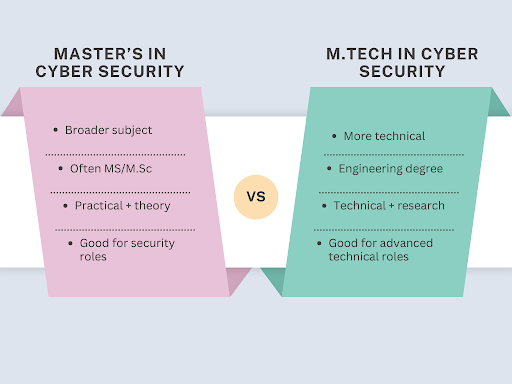
An M.Tech in Cyber Security is a master’s degree that focuses on subjects. M.Tech in Cyber Security is best for students who already have a background in engineering, computer science, IT or a similar field. M.Tech in Cyber Security students can learn about system security, cryptography, cyber forensics and hardware security. For instance the M.Tech in Cyber Security offered by IIT Delhi has specialisations, in system security and cyber forensics, cryptography and embedded‑system security.
An MBA in Cyber Security is a bit different from a cybersecurity degree. It joins two fields: business and cybersecurity. Students discover how a company runs and at the time how to handle online threats, safeguard company data and prepare for cyber attacks. Thus an MBA in Cyber Security focuses more on the business side of cybersecurity than learning how to locate and solve technical issues.
An MBA in Cyber Security can help students and professionals who wish to advance toward management and leadership positions in cybersecurity. Subjects may cover business strategy, finance, management, cyber risk, data protection, security planning and information security. In terms an MBA in Cyber Security lets students grasp both business operations and how to protect those operations from cyber threats.
Institute | Programme | State | Key Focus | Type |
National Forensic Sciences University | MBA Cyber Security Management | Gujarat | Cyber Management | MBA |
Gujarat University | I-MBA Cyber Security Management | Gujarat | Business + Cyber | Integrated |
National Forensic Sciences University | Cyber Security Management | Gujarat | Risk + Security | Management |
Other business schools | Cybersecurity Specialisation | Gujarat | Business + Security | MBA |
Selected universities | Cyber Management | Gujarat | Security Strategy | MBA |
NFSU provides a MBA in Cyber Security Management, which focuses on security planning, risk assessment, security controls and the management of cybersecurity inside an organisation. Gujarat University also offers a MBA in Cyber Security Management blending business courses with topics such as ethical hacking and network security.
Institute | Country | State/Region | Key Focus | Programme |
Florida International University | USA | Florida | Cyber Risk | MBA |
Florida Institute of Technology | USA | Florida | Cyber Management | Online MBA |
University of West Florida | USA | Florida | Security Management | MBA |
American University | USA | Washington, D.C. | Cyber Risk | Online MBA |
Coventry University | UK | England | Cyber Management | MBA |
Lancaster University | UK | England | Cyber Leadership | Executive MBA |
Baylor University | USA | Texas | Cyber Strategy | MBA |
Oregon State University | USA | Oregon | Information Security | MBA |
Florida International University offers an MBA in Cyber Security Risk Management, which blends standard MBA courses with strategies and risk management for cybersecurity. Florida Tech provides an MBA in Cyber Security and the University of West Florida offers an MBA that stresses Cyber Security Management.
In the United Kingdom, Coventry University presents an MBA path in Cyber Security Management whereas Lancaster University offers an Executive MBA in Cyber Security that targets professionals. Baylor University and Oregon State University also incorporate cybersecurity management or cyber security‑focused content in their MBA programmes.
Overall, an MBA in Cyber Security is an option for anyone who does not wish to devote their whole career to technical cybersecurity tasks but still desires to comprehend cybersecurity and assume management, planning or leadership duties.
Cyber attacks are getting smarter. Finding every threat by hand is not always easy. That is where AI in cybersecurity can help. AI can scan amounts of data, spot unusual activity and quickly alert security teams about a possible attack. Simply put, AI and cybersecurity work to spot online threats faster and keep systems, accounts and data safe. That is why AI is becoming a part of modern cyber security courses, B Tech Cybersecurity and Master’s in Cyber Security programmes.
AI does not completely replace cybersecurity professionals. Instead AI gives them another tool to find problems, understand risks and protect systems more effectively. As businesses use AI and online services, learning about both AI and cybersecurity opens new career opportunities, in the growing cyber security field.
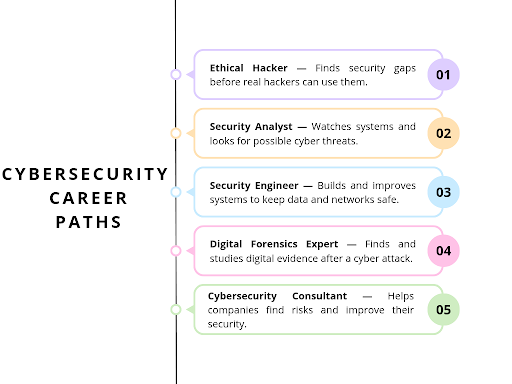
Cybersecurity offers career paths for students who like technology, solving problems and keeping the online world safe. Here are some common jobs, in this field:
A degree can help build a base but cybersecurity certifications can help students and professionals show what they can actually do. These certifications focus on skills such as network security, ethical hacking, cyber attacks, risk and data protection. They can be useful cybersecurity courses after 12th, B Tech Cybersecurity or even a Master’s in Cyber Security.
Certifications can add value to a degree such as B Tech in Cyber Security, MTech in Cyber Security, MSc Cyber Security or Master of Science in Cybersecurity. They can help students learn a skill instead of studying only broad cybersecurity topics. They may also make a resume stronger when applying for internships or jobs.
For professionals, certifications can also be useful when moving into a cybersecurity role. Someone in this background may choose ethical hacking or network security while someone interested in management can look at certifications related to cyber risk and security management. This can also be useful for people considering an MBA in Cyber Security.
The best certification depends on the person's knowledge and career goal. A beginner can start with an entry-level certification while someone with experience can choose an advanced option. Along with Masters in Cyber Security and other cyber security masters programmes, certifications can help build more focused skills for a career in cybersecurity.
India is growing more online each year. People now use the internet for banking, shopping, school work, office tasks, paying bills and many other daily needs. This has made life easier. It has also brought more online risks for cybersecurity. As private and company data moves online the need for better cybersecurity also grows.
Banks, hospitals, schools, companies, government offices and small businesses all need to protect their systems and data. Cyber attacks can lead to stolen passwords, loss of money, leaked data or problems with services. Because of this organizations spend time and effort on cybersecurity and look for trained professionals who can handle these problems.
India is also seeing interest in AI in cybersecurity as companies look for swifter ways to find online threats. This means the field is not limited to computer security anymore. For students and professionals learning cybersecurity along with AI, cloud security, hacking and data protection can create more career options, in India's growing online world.
There are cybersecurity courses to choose from and it is normal to feel confused. The best cybersecurity course is not necessarily the one with the name. The right cybersecurity course should match the student’s interests, education and future plans.
First think about the kind of work that sounds interesting. A student who enjoys computers and solving problems may prefer a technical cybersecurity course. A student who likes planning, leading people and handling business problems may enjoy the management side of cybersecurity.
If you like tech work choose a cybersecurity course that focuses on computers, networks and security.
If you are interested in hacking, look for a cybersecurity course that teaches hacking in a safe and legal way.
If you like AI and new technology look for a cybersecurity programme that includes AI and cybersecurity.
If you are interested in research, a master's cybersecurity programme that includes research may be a choice.
If you want to manage people or businesses an MBA with a cybersecurity focus can be useful.
Before applying, check whether the cybersecurity course accepts the subjects studied in Class 12 or graduation. Some cybersecurity courses may ask for Mathematics or a computer‑related subject while others may accept students from backgrounds.
For a master’s cybersecurity degree the university may ask for a type of bachelor’s degree. Some colleges may also have an entrance test while others may select students based on marks. Checking these rules before applying can save a lot of time.
Students can choose between classroom cybersecurity courses and online cybersecurity courses. A regular cybersecurity course may be better for someone who wants classroom learning, college activities, labs and direct help from teachers. An online master’s in cybersecurity can be useful for people who need freedom with their study time, especially working professionals.
A degree is not the way to learn cybersecurity. Students can also take certifications to learn a skill, such as ethical hacking, network security or security management. These certifications can be done during college or after completing a degree. Can add useful skills to a resume.
In the end there is no cybersecurity course that is perfect, for everyone. The best cybersecurity course is the one that feels right for the student’s interests, education and career plans. Taking some time to compare cybersecurity courses before applying can make the choice much easier.
Cybersecurity is no longer something that only computer experts need to worry about. As more of our lives move online the need to keep information and digital systems safe is also growing. This has opened up study and career choices for students from cybersecurity courses after 12th and B Tech in Cyber Security to Masters in Cyber Security, MTech and MBA programmes.
The important thing is to choose a path that matches interests and future plans. Some people may enjoy work while others may prefer AI, research, ethical hacking or management. With the course, practical skills and a willingness to keep learning a career, in cybersecurity can start with the next step taken today.
Yes. Students who like computers, technology and solving puzzles can think about cybersecurity courses after Class 12.
No. You do not have to be a computer expert to study cybersecurity. Having basic computer knowledge helps. You will learn all important cybersecurity topics during the course.
An MBA can be useful for people who're more interested in the business and management side. An MBA in Cyber Security can help with risk, planning, management and decision making in security.
Yes. AI in cybersecurity is becoming important. AI can help find activity, spot threats and make cybersecurity work faster.
Yes. Certifications can help build skills and can make a student's profile stronger. The right certification depends on the person's experience and career goal.
Yes. There are cybersecurity courses and online Masters in Cyber Security programmes. They can be useful for people who need flexibility while studying.
There are paths, including ethical hacking, security analysis, digital forensics, security engineering, consulting and security management.
Read more: Cyber Security: A key Course in Information Technology
To further advance academic excellence, IIRF has expanded its reach through diverse initiatives, including ICOSA for school accreditation, study abroad programs, and specialized online courses.