
October 26th, 2026
Think about what happens when you send money to someone online, when you sign a digital agreement or when you buy something from a website. In each case you trust that the system will record your action correctly. You trust that the information stays safe. What if the people using the system do not trust each other? What if there is no authority to vouch for the transaction? How can they agree that a transaction is real without relying on one point of control?
This is the kind of problem blockchain technology was built to solve. Solving it isn’t just about understanding cryptocurrency. It’s about rethinking how data is shared, how trust is created in a world and how systems can work together without needing a middleman.
For years skills like databases, networking and cloud computing were seen as optional. Engineers could pick them up if they wanted to. Today those skills are essential. They are part of the core toolkit of any software developer. Blockchain is following a path. It’s no longer a topic for finance experts or blockchain enthusiasts. It's becoming a skill for anyone building modern software systems.
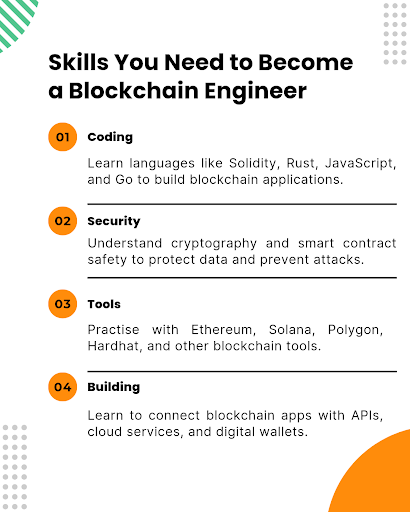
Now you can take a blockchain course. You can earn a certificate. That’s not the same as learning blockchain engineering. A course can give you an idea. Real blockchain engineering requires a deeper understanding. You need to know how computers share data across a network. You need to understand how data stays secure even when it’s stored in places. You need to learn how these distributed systems reach agreement, this is often called consensus. One needs to learn how smart contracts work, how they can run code automatically and how they can manage real-world actions.
This shift is not just theoretical. Industry data shows that the interest in blockchain is growing fast. According to Fortune Business Insights the global blockchain technology market was valued at around $20.16 billion in 2024. Experts predict it will grow to $393.42 billion by 2032. Course market forecasts don’t guarantee jobs. They do show that businesses are paying attention. They are looking for ways to use blockchain in applications.
We see blockchain being used in finance. We see it in supply chains. We see it in identity systems. We see it in record-keeping, for health data land titles and more. For software engineers this means a chance to build kinds of applications, distributed applications that run on blockchain. It means building software that can work without a server, software that can be trusted even when no one trusts anyone else.
In this article we will explore why blockchain is becoming an engineering skill. We will look at what students can learn through a degree or a specialized program. We will review the topics a good syllabus should include. We will talk about the skills needed to work in this field. We will look at the career options. We will examine what salaries you might expect. We will discuss the things to consider before choosing a course.
Our goal is simple. We want you to see blockchain not as another certificate to add to your resume. We want you to see it as an engineering skill. A skill that can become part of your long-term career. A skill that helps you build systems, not just understand theory. Blockchain isn’t a course. It’s the core engineering skill.
Imagine Blockchain as a way to keep and share information that's hard to change secretly. It lets people check whether a record is real track changes and share data without needing one owner. That is why Blockchain is useful beyond money on the internet. Banks can use Blockchain to help with payments, companies can watch products as they travel through supply chains and hospitals can look at ways to share records safely. Blockchain can also help with identity, land records turning real assets into tokens and new digital money from central banks. In other words , Blockchain solves real problems wherever people need solid records and a clear history of moves.
Blockchain touches topics that software engineers already learn such as databases, computer networks, cybersecurity, cryptography and distributed systems. Today a software engineer might need to know how Blockchain works inside an app, how users link their wallets or how a smart contract talks to other parts of a product. That is why Blockchain for software engineers is about more than writing smart contracts. Companies building products on Blockchain need engineers who can blend this technology with software systems. A good Blockchain engineer course should teach both Blockchain ideas and the hands‑on skills to build, test and keep applications.
The difference is simple: learning Blockchain as a course means studying the basics, finishing lessons and maybe getting a certificate. Learning Blockchain as an engineering skill means knowing when to use it, how to build with it and how to fix problems using it. As more Web2 developers look at Web3 skills like working with APIs, connecting wallets and adding contracts become useful extra tools. Blockchain may not be needed for every software job. Knowing it can help engineers open more doors. I see that learning Blockchain gives a view of what software can do. I think it prepares engineers for more chances in the future.
If you want to learn about blockchain you will find many Blockchain Engineering Courses to choose from. Some Blockchain Engineering Courses teach the basics. Others show how to build using blockchain. You can choose a certificate Blockchain Engineering Course, a diploma, a bootcamp, a B.Tech specialisation, a full degree, an M.Tech or MS programme or a course made for working professionals. If you have just passed Class 12 you can look at degree Blockchain Engineering Courses. If you are already working or want to move into a career a short Blockchain Engineering Course may be a good place to start.
Course Type | Duration | Best For | Depth of Learning | Typical Outcome |
Short certificate / MOOC | 4 to 12 weeks | Beginners, students | Conceptual + basics | Awareness, portfolio start |
Bootcamp (Solidity/Web3) | 3 to 6 months | Developers, switchers | Hands-on dApp building | Junior Web3 developer |
Postgraduate diploma | 6 to 12 months | Working professionals | Applied and domain-focused | Role upgrade |
B.Tech CSE with blockchain specialisation | 4 years | Class 12 (PCM) students | Deep, integrated with CS core | Blockchain / software engineer |
M.Tech / MS (Blockchain, Distributed Systems) | 1 to 2 years | Graduates | Research + advanced | Architect, researcher |
Executive / strategy programme | 2 to 6 months | Managers, founders | Business and governance | Strategy and product roles |
The main difference is what you learn. Basic Blockchain Engineering Courses help you understand what blockchain is and how people use it. Blockchain Engineering Courses that focus on engineering teach you how to work with this technology. You learn how to write code, build contracts and create applications using blockchain. A good Blockchain Engineering Course should give you a chance to practice what you learn by only reading about it. Before choosing a Blockchain Engineering Course check the topics, fees, duration and practical work included. Choose a Blockchain Engineering Course that matches your knowledge and your future goals.
B.Tech in Blockchain Technology is a choice for someone who wants to study blockchain after finishing Class 12. There is a small catch. Many Indian colleges teach blockchain as a specialisation under Computer Science and Engineering (CSE). In words B.Tech in Blockchain Technology starts with learning computer science then moves to studying how blockchain works and how to build applications with blockchain.
The actual fees depend on the college. Always check the college website.
Already have a diploma? Some colleges allow eligible diploma holders to join the year. This is called lateral entry.
The names can be confusing so check what each course actually teaches.
The course name alone does not tell B.Tech in Blockchain Technology everything. What B.Tech in Blockchain Technology learns and what B.Tech, in Blockchain Technology can build are important when applying for jobs.
In a B.Tech in blockchain technology you don't learn everything about blockchain in the year. You start with the basics. Move to harder topics each year. In the year you learn coding, maths and computer basics. In the year you learn how computers share information, how data is stored and how to keep it safe. In the year you start learning more about blockchain, smart contracts and how to build blockchain-based apps. In the year you may work on a bigger project or do an internship to get some practical experience. This is how the B.Tech blockchain syllabus may look. Every college has its own subjects. So check the syllabus before choosing a blockchain engineering degree.
| Year | Core CS Subjects | Blockchain-Specific Subjects | Practical / Tools |
| Year 1 | Programming (C/Python), Maths, Physics, Digital Logic | Intro to computing and the internet | Python, Git, Linux basics |
| Year 2 | Data Structures, Algorithms, DBMS, OS, Computer Networks | Cryptography fundamentals, Discrete Maths | Java/C++, SQL, hashing labs |
| Year 3 | Distributed Systems, Software Engineering, Cloud Computing, Cybersecurity | Blockchain Architecture, Consensus Mechanisms (PoW, PoS, BFT), Smart Contracts, Ethereum and Hyperledger | Solidity, Hardhat/Truffle, Web3.js/Ethers.js, MetaMask |
| Year 4 | Electives, Machine Learning, Capstone Project | DeFi, Tokenomics, Blockchain Security and Auditing, Blockchain Interoperability, Legal and Regulatory Aspects, Zero-Knowledge Proofs | Rust/Go, IPFS, Layer-2 tools, internship, capstone dApp |
If you want to study blockchain in India you will find options. Some private universities offer a B.Tech in blockchain technology or CSE with a blockchain specialisation. IITs, IIITs and NPTEL are also places to look for blockchain research, technical learning and online courses. The Indian government is exploring blockchain through its National Blockchain Framework while the RBI has been testing the e-Rupee, a version of the Indian rupee. India also has a blockchain developer community with events such as ETHIndia where developers come together to build projects and share ideas. Below are some blockchain engineering courses, colleges and learning options worth exploring.
| Institution | Programme | Level | Notes |
| VIT (Vellore / Chennai) | B.Tech CSE with specialisation in Blockchain Technology | UG | Established blockchain track, strong placements |
| SRM Institute of Science and Technology | B.Tech CSE with specialisation in Blockchain Technology | UG | Industry tie-ups |
| UPES Dehradun | B.Tech CSE with specialisation in Blockchain | UG | Industry-linked curriculum |
| Chitkara University | B.Tech CSE with blockchain specialisation | UG | Check current offering |
| Lovely Professional University (LPU) | B.Tech CSE with blockchain specialisation | UG | Check current offering |
| Amity University | B.Tech CSE with blockchain specialisation | UG | Check campus-wise availability |
| KL University | B.Tech CSE with blockchain specialisation | UG | Check current offeringFree and low-cost learning, strong brand |
| IIT Madras (NPTEL / Pravartak) | Blockchain Architecture Design and Use Cases; blockchain research | Online / Research | Research-focusedCheck current offering |
| IIIT Hyderabad | Blockchain-related electives, research | UG / PG | Government-backed, affordable |
| NIELIT | Blockchain certification and training | Certificate |
If you want to study blockchain outside India you will find courses at universities in countries like the US, UK, Switzerland, Singapore, Hong Kong and Cyprus. However blockchain is not always offered as a degree. Many universities teach it through master’s programmes, research centres, computer science subjects or short courses for working professionals. So when looking for a blockchain engineering degree or blockchain engineer degree check what each programme actually teaches. Some focus on coding and building blockchain applications while others focus more on research or business. Rules around blockchain and cryptocurrency also differ between countries. For example the EU has MiCA rules for crypto‑assets while the US and Singapore continue to develop and apply their rules. These differences are worth checking before choosing a university or planning to work. The table below lists some options for exploring blockchain courses and blockchain engineering courses.
| University / Provider | Country | Programme / Centre | Level | Focus |
| MIT | USA | Digital Currency Initiative; blockchain and money courses | Research / Short courses | Cryptocurrency, policy, technology |
| Stanford University | USA | Center for Blockchain Research | Research / Courses | Security, applications |
| UC Berkeley | USA | Berkeley RDI; blockchain courses | Courses / Research | Decentralised systems, Web3 |
| Cornell University | USA | Initiative for Cryptocurrencies and Contracts (IC3) | Research | Smart contracts, security |
| University of Oxford (Saïd) | UK | Blockchain Strategy Programme | Executive | Business and strategy |
| University College London | UK | Centre for Blockchain Technologies | MSc / Research | Technical and financial |
| ETH Zurich | Switzerland | Distributed systems and cryptography research | MS / PhD | Cryptography, security |
| University of Nicosia | Cyprus | MSc in Digital Currency | Master’s | Digital currencies, early pioneer |
| National University of Singapore | Singapore | Blockchain-related courses and research | UG / PG | Fintech and applied blockchain
|
| Coursera / edX / Consensys Academy / Ethereum.org | Online | Blockchain specialisations and developer tracks | Online | Flexible, affordable learning
|
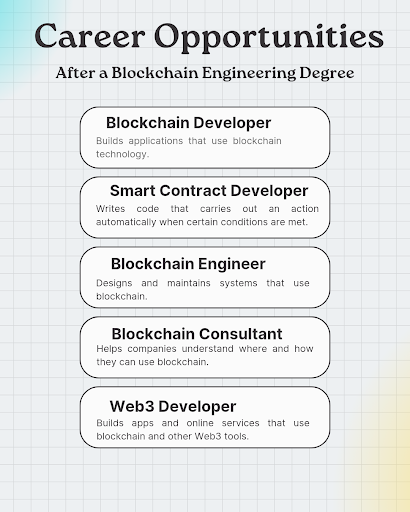
A blockchain engineer degree can open doors to jobs in software development and blockchain technology. It is not always required to have a job title that contains the word blockchain. Many companies look for software engineers who know how to work with blockchain, smart contracts and digital applications. Banks, IT companies, consulting firms, fintech businesses and Web3 startups may hire people who have these skills. Here are eight job roles you can explore after completing a blockchain engineer course or a B.Tech, in blockchain technology.
The salary of a Blockchain Engineer depends on the skills of the Blockchain Engineer, the work experience of the Blockchain Engineer, the projects the Blockchain Engineer works on and the company the Blockchain Engineer joins. Earning a degree for a Blockchain Engineer or finishing courses on Blockchain can help. Practical knowledge for a Blockchain Engineer matters too.
In India and abroad companies are exploring Blockchain for payments, identity records and other business needs. However crypto-related jobs can go through ups and downs so it is better for a Blockchain Engineer to learn skills such as coding, security and computer networks in addition to Blockchain. These skills can also help a Blockchain Engineer apply for software jobs.
The table below gives an idea of salary ranges for a Blockchain Engineer in India and other countries.
| Level | India (Annual, approx.) | USA (Annual, approx.) | Europe / UK (Annual, approx.) |
| Fresher (0 to 2 years) | ₹4 to 10 LPA | $80,000 to $120,000 | €45,000 to €70,000 |
| Mid-level (3 to 6 years) | ₹12 to 25 LPA | $120,000 to $170,000 | €70,000 to €100,000 |
| Senior (7+ years) | ₹25 to 50+ LPA | $170,000 to $250,000+ | €100,000 to €150,000+ |
These figures are estimates, not guaranteed salaries for a Blockchain Engineer so check listings on Glassdoor, LinkedIn, Levels.fyi or AmbitionBox before making a decision.
Choosing a blockchain course can feel confusing because there are options. So before joining any course take some time to check what the course teaches. Do not choose a course just because the course has the word "blockchain" in its name. You should also learn coding, computer science and online security. These basics will help you understand how blockchain works. I have found that a clear syllabus makes the decision easier.
Try to find a course where you can practise what you learn. For example you should get a chance to write code, make projects and learn how smart contracts work. Also check the course fees, teachers, internship options and placement support. If you are choosing a B.Tech programme, compare colleges before making a decision. A good course should teach you skills, give you time to practise and fit your budget. I have found that courses with hands-on labs are helpful.
1. Can I study B.Tech in blockchain technology in India?
Yes some colleges offer B.Tech in blockchain technology. Teach blockchain as part of Computer Science and Engineering. The course name and subjects may be different at each college.
2. What do students learn in the B.Tech blockchain syllabus?
The B.Tech blockchain syllabus may cover coding, computer networks, databases and online security. Students may also learn how blockchain works and how to create contracts.
3. Can software engineers learn blockchain without a degree?
Yes. Software engineers can learn through blockchain courses, lessons and practice. They can start with projects and slowly learn more advanced skills.
4. Is a blockchain engineering degree worth studying?
Blockchain can be worth it if you enjoy coding and want to work in this field. Before choosing a blockchain engineering degree check what you will study and whether you will get to work on real projects.
5. Which course should I take to become a blockchain engineer?
Choose a blockchain engineer course that teaches you how to write code, build contracts and keep digital information safe. A course with projects can help you understand these things better.
6. Is blockchain used for cryptocurrency?
No. Blockchain in software development can be used for more than money. For example blockchain can help businesses track products, store records and share information.
When people hear the word blockchain they often think of Bitcoin or cryptocurrency.. Blockchain can do more than that. Blockchain can help people store information, keep records and share data in a way that's difficult to change without permission. This is why learning about blockchain can be useful for students who want to build a career in technology. I have seen students surprised by how versatile blockchain is.
If you want to learn blockchain you do not have to rush into a course straight away. Start by learning coding and the basics of computer science. After that you can choose a college degree, online lessons or blockchain engineering courses. Try making a project and learn how smart contracts work. I recommend starting with a project before enrolling in a full programme. If you are thinking about computer science and engineering with specialisation in blockchain technology check the subjects, fees and practical training before choosing a college. If you already work in software blockchain, for software engineers courses may help you learn skills without starting from the beginning.
Remember, watching lessons is the first step. You also need to practise, make mistakes and try again. You do not need to become an expert these days. Take your time. Keep learning. A course can show you where to start. What you learn and build along the way will help you grow.
Also Read: Blockchain Demystified: A Banking Sector Perspective, Top 9 Universities Offering Online Blockchain & Cryptocurrency Courses, and Trending Blockchain and Cryptocurrency Jobs for Freshers in India
To further advance academic excellence, IIRF has expanded its reach through diverse initiatives, including ICOSA for school accreditation, study abroad programs, and specialized online courses.