
August 26th, 2026
Imagine you have a problem that usually takes hours to solve. Someone gives you the answer in just seconds. Now imagine a computer that can solve complicated problems in a completely new way different from the computers we use today. This is where quantum artificial intelligence comes in. Quantum artificial intelligence is like a combination of two things: the problem-solving power of quantum computing and the learning abilities of artificial intelligence.
To understand how this works lets look at how normal computers work. They use something called bits to store information. These bits can only be 0 or 1. A quantum computer uses something called quantum bits or qubits for short. These qubits can handle information in more complicated ways. This means that quantum computers can look at complicated problems much faster than our regular computers. When you combine this technology with intelligence, quantum artificial intelligence and artificial intelligence can potentially make machines learn better, look at huge amounts of information and find answers to difficult problems.
People around the world are getting excited about the possibilities of quantum artificial intelligence. For example healthcare companies could use artificial intelligence to help find new medicines, financial organisations could use it to manage risk better and industries could use it to make complicated plans and optimise things. Even governments, universities and technology companies are spending a lot of money on this field. Companies like Google Quantum AI, IBM and Microsoft are working on quantum technologies and doing research.
Quantum artificial intelligence is not just about making computers work faster. It could actually change the way we approach some of the world's difficult problems. This article is going to explore what quantum artificial intelligence really means, how quantum computing works with artificial intelligence, where we can use it, which organisations are developing it and what the future of quantum artificial intelligence could look like. To really understand this technology we need to start with the basic idea behind quantum computing.
Quantum artificial intelligence is when we use ideas from quantum computing to make intelligence systems better at solving problems, learning from information and making decisions. Quantum artificial intelligence brings together two technologies: artificial intelligence, which helps computers learn and make predictions and quantum computing which uses special rules of physics to process information differently.
To understand this better let us first look at how artificial intelligence works. Normal artificial intelligence uses computers to study vast amounts of data and find patterns. Artificial intelligence lets a system learn from data. Some can even handle tasks like recognizing pictures, understanding language and making predictions. These systems usually run on computers that use CPUs or GPUs.
Quantum computing is different. In lieu of using regular bits that can only be 0 or 1, quantum computers use special bits called qubits. A qubit can be a blend of things at the same time, which is called superposition. Quantum computers can also connect qubits in a way, which is called entanglement. This allows quantum systems to handle complex calculations that regular computers cannot do easily.
So what happens when artificial intelligence and quantum computing come together? The basic idea is to use computers or quantum methods to handle specific parts of artificial intelligence problems. For example quantum methods can help with finding the solution, finding patterns, simulating things or handling complex math problems. This combination is often called quantum artificial intelligence.
A simple way to think about it is to imagine finding the route through a huge city. A regular computer may check possible routes using traditional methods. A quantum computer does not just try every answer at once. Its special properties can help solve certain problems in a completely different way. When artificial intelligence is added the system can use those results to learn, predict or make decisions.
However quantum artificial intelligence is not a faster version of normal artificial intelligence. Its real importance is that quantum computing may allow researchers to develop ways of solving certain problems that are very difficult for regular computers. This is why quantum artificial intelligence is being studied as a direction for artificial intelligence rather than just an upgrade to existing technology.
The difference between artificial intelligence and quantum artificial intelligence becomes clearer when we compare them directly:
| Factor | Classical AI | Quantum AI |
| Processing Unit | CPU / GPU | Qubit-based quantum processor |
| Data Processing | Sequential or parallel bit processing | Quantum superposition — processes many states simultaneously |
| Algorithm Optimisation | Gradient descent, backpropagation | Quantum annealing, variational quantum algorithms |
| Speed for Complex Problems | Limited by classical computation | Exponentially faster for specific problem types |
| Error Rate | Low and manageable | Currently high — error correction is a major research focus |
| Current Maturity | Highly mature — commercial deployment | Early stage — research and pilot deployment phase |
| Best Use Cases | General AI tasks — image recognition, NLP | Optimisation, drug discovery, materials science, cryptography |
The table also shows why it is important not to overstate the current abilities of quantum artificial intelligence. Classical artificial intelligence is already widely used, while quantum artificial intelligence is still developing. Today's quantum computers have limitations, including errors and a relatively small number of useful qubits.
Researchers are therefore focusing on finding situations where quantum computing can actually provide an advantage. This means achieving an improvement over the best available classical approach for a particular task. Quantum advantage does not mean that quantum computers will be faster at everything; instead the goal is to find artificial intelligence and computing problems where quantum methods can offer a real benefit.
For now quantum computing applications in intelligence remain an active area of research. The technology has possibilities but it is still too early to say that quantum artificial intelligence will replace classical artificial intelligence. The important question therefore is where this combination can actually be useful in the real world. Quantum artificial intelligence is an exciting field that brings together quantum computing and artificial intelligence and it has the potential to solve complex problems in a completely different way. Quantum artificial intelligence is still developing. It is an area that is worth exploring and it may lead to new breakthroughs in the future.
To understand how quantum computing artificial intelligence works it is important to understand three basic ideas: qubits, superposition and entanglement. These quantum computing artificial intelligence ideas may sound difficult. The basic concept of quantum computing artificial intelligence can be explained quite simply.
A qubit is the unit of information in a quantum computer. A normal computer uses bits which're either 0 or 1. A qubit can hold a combination of 0 and 1 because of a property called superposition. Think of a light switch: it is either ON or OFF. A qubit is like a dimmer switch, where different possibilities can exist before a final result is measured for the qubit.
Another important property of quantum computing intelligence is entanglement. When two qubits become entangled their states become connected in a quantum way. Changing or measuring one qubit can provide information about the qubit even when they are separated. A simple way to imagine this is having two connected coins: the result of one coin is linked to the result of the other coin.
The third idea is interference. Quantum systems can be designed so that some possible answers become stronger while others become weaker or cancel out for the quantum systems. It is similar to waves in water: some waves. Become bigger while others can cancel each other. In artificial intelligence this property of quantum artificial intelligence can help quantum algorithms move toward useful solutions for particular problems.
Together these properties of quantum computing intelligence make quantum computing different from classical computing. They do not mean that a quantum computer simply checks every answer at the time. Instead quantum algorithms carefully use superposition, entanglement and interference to solve types of problems in a new way for quantum computing artificial intelligence.
Quantum machine learning is one of the important areas of quantum artificial intelligence. It combines machine learning techniques with quantum computing to explore whether quantum systems can improve learning and optimisation tasks for quantum machine learning.
Several machine learning algorithms are being studied today:
These methods of quantum machine learning do not outperform artificial intelligence in every situation. Their possible advantage depends on the problem of the algorithm of quantum machine learning.
Quantum AI platforms are really important because they let researchers and developers use quantum computers and tools without having to buy a computer. This is great because most of these platforms are available online, which makes it easier for people to try out quantum computing and artificial intelligence.
As it becomes easier to use these platforms students, researchers and companies can try out quantum artificial intelligence. Quantum AI platforms could really help speed up research and make artificial intelligence a reality that we can use in the real world. Quantum AI platforms are going to be really important for the future of artificial intelligence.
Quantum AI is being used in areas like healthcare and finance and also in cybersecurity and clean energy. Most of these uses of quantum computing are still being tested. They can help solve problems that are really hard for regular computers.
Quantum AI can help scientists understand how molecules work and find medicines faster. It can use quantum simulations and AI together to study how molecules interact and find good candidates for new drugs.
Finance is about making decisions from a lot of possibilities. Quantum AI can help with making the portfolio understand risks, detecting fraud and some kinds of automated trading.
Future quantum computers might be able to break some of the encryption systems we use today. This means we need -quantum cryptography to keep our digital information safe from quantum attacks.
Finding materials is another important use of quantum computing. Quantum systems can help scientists study materials at a small scale and find better solutions for energy and environmental problems.
Companies often need to find the way to deliver things or make a schedule from many possibilities. Quantum AI can help solve some of these problems.
Climate systems are very complex making them hard to model accurately. Quantum computing applications can eventually help with climate simulations, weather research, ocean modelling and planning to capture carbon.
Healthcare creates a lot of genetic data. Quantum artificial intelligence can eventually help analyse images, study genetic information and find patterns linked to diseases.
Overall quantum AI is still developing and has many possible uses. As quantum computers become more powerful and reliable these early experiments can become solutions, in many industries. Quantum AI is really changing things and quantum AI will continue to do so.
Google Quantum AI is working hard to make quantum computing useful. They started doing research on this in the 2010s. Brought together a lot of smart people like scientists and engineers to work on it. Google Quantum AI has become a name in the field of quantum computing AI because of all the work they have done.
Google Quantum AI is focused on main things, including:
If you are interested in working with Google Quantum AI they have jobs for people with backgrounds in physics, computer science and other related fields. You can look for these jobs on Google's website. Researchers can also use Google's software and resources to learn more about quantum AI.
Overall Google Quantum AI is trying to make quantum computing more useful. They want to get to a point where quantum computers can help us solve problems that regular computers cannot. Google Quantum AI is about making progress towards this goal, which is called quantum advantage. Google Quantum AI is working hard to achieve this goal and make Google Quantum AI a leader in the field of quantum computing.
Looking to start a career in AI? There are ways to get into this fast-growing area, from bachelors degrees and masters, in quantum computing to doctorates and online learning opportunities.
To work in quantum AI you need to know about computing and science. You can start by studying Computer Science, Physics, Mathematics, Electrical Engineering or Quantum Engineering.
These subjects are really useful: algebra, probability, algorithms, programming and quantum mechanics. If you do a B.Tech in Computer Science you will learn a lot about programming and AI. If you study Physics you will understand quantum systems better.
Sometimes people ask what is the way to start. You can start with a degree in one of these subjects. Then move to quantum AI later.
| University | UG Programme | Course Type |
| IIT Mandi | B.Tech in Quantum Science & Engineering | Direct UG Degree |
| SRM University-AP | B.Tech in Quantum Computing & Engineering | Direct UG Degree |
| Amrita Vishwa Vidyapeetham | B.Tech CSE – Quantum Computing | CSE Specialisation |
| The NorthCap University | B.Tech CSE – Quantum Computing | CSE Specialisation |
| RVR & JC College of Engineering | B.Tech in Quantum Computing | Direct UG Degree |
| University | Country | UG Programme | Course Type |
| UNSW Sydney | Australia | Bachelor of Engineering (Hons) – Quantum Engineering | Direct UG Degree |
| University of Waterloo | Canada | Computer Science + Quantum Information Pathway | CS Pathway |
| University of Bristol | UK | BSc Physics + Quantum Technology | Physics Pathway |
| University of Colorado Boulder | USA | Engineering + Quantum Engineering Minor | Engineering Pathway |
| TU Delft | Netherlands | BSc Applied Physics + Quantum Technology | Physics Pathway |
Masters in Quantum Computing & Quantum AI. A Global Guide
If you want to work in quantum computing research, a masters degree is a great idea. You can study quantum computing, quantum information, quantum engineering, AI or physics.
| University | Master’s Programme | Course Type |
| IIT Madras | M.Tech in Quantum Science & Technology | Direct quantum degree |
| IISc Bengaluru | M.Tech in Quantum Technologies | Direct quantum degree |
| IIIT Allahabad | M.Tech in Quantum Information & Technologies | Direct quantum degree |
| IIT Jodhpur | M.Tech in Quantum Technologies | Direct quantum degree |
| DIAT Pune | M.Tech in Quantum Computing | Direct quantum degree |
| University | Country | Master’s Programme | Course Type |
| MIT | USA | EECS/Physics with Quantum Computing & Quantum Information | Departmental pathway |
| University of Waterloo | Canada | MSc Physics – Quantum Technology specialisation | Physics + Quantum specialisation |
| ETH Zurich | Switzerland | MSc Quantum Engineering | Direct quantum degree |
| University of Oxford | UK | MSc in Quantum Technologies | Direct quantum degree |
| TU Delft + Leiden University | Netherlands | MSc Quantum Information Science & Technology | Joint quantum degree |
For example ETH Zurich has a two-year MSc in Quantum Engineering that covers quantum theory and engineering. IIT Madras has an M.Tech in Quantum Science and Technology that covers quantum computing, quantum machine learning and post-quantum cryptography. IISc has an M.Tech in Quantum Technology that covers computation, simulations, communication and cryptography.
If you want to work in research, develop technologies or teach, you can do a PhD in quantum computing. It usually takes 4-6 years depending on the country and research area.
You can research algorithms, quantum machine learning, error correction, quantum hardware and quantum information theory. Many universities and research centres such as MIT, Caltech, Waterloo/Perimeter Institute, ETH Zurich, Cambridge, TU Delft, University of Tokyo and UNSW are working on research.
You can get funding for your PhD through scholarships, fellowships or research positions. After you finish your PhD you can work in universities, technology companies, research laboratories or quantum AI startups.
You do not need a quantum computing degree to work in the field. Online courses can help you build skills before moving into advanced quantum computing research.
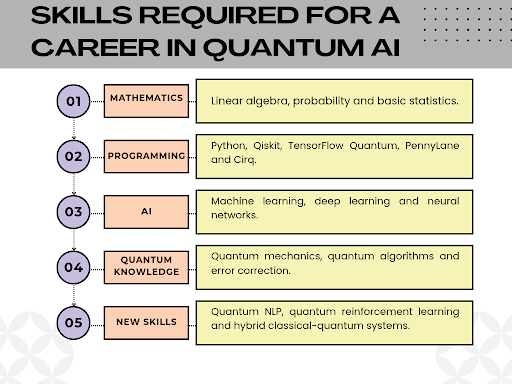
You can follow this simple path: learn basic mathematics then learn Python, then classical AI then quantum computing basics then Qiskit/TensorFlow Quantum, then quantum machine learning and finally work on projects and research. This way you can move towards AI without doing a full-time degree right away. You can learn about quantum AI, then decide if you want to do more. Quantum AI is a massive field to work in and you can start learning about it today.
For students and professionals and researchers quantum AI is a field that has a lot of opportunities to learn, experiment and build things. Universities and research centers and governments from around the world are putting money into quantum computing research, which means there are more opportunities for people who want to work in quantum artificial intelligence.
There are institutions that are working on quantum computing and AI. Some of these institutions focus on the hardware while others work on algorithms, error correction or quantum machine learning.
| Institution | Country | Research Focus |
| Google Quantum AI | USA | Quantum hardware, error correction, QML |
| IBM Research | USA | Quantum algorithms, Qiskit ecosystem |
| Microsoft Research | USA | Topological qubits, Azure Quantum |
| MIT Center for Quantum Engineering | USA | Quantum systems, algorithms |
| Perimeter Institute | Canada | Quantum information theory |
| QuTech | Netherlands | Quantum internet, quantum hardware |
| Max Planck Institute | Germany | Quantum optics, quantum simulation |
| RIKEN | Japan | Quantum computing hardware |
| National Quantum Computing Centre | UK | Applied quantum research |
| Centre for Quantum Technologies | Singapore | Quantum cryptography, algorithms |
Governments are also spending a lot of money on quantum technology because it can have a big impact on science, security and industry.
Researchers can get this help through university grants and research fellowships and government programmes and industry partnerships. Students who are doing a PhD in quantum computing can also get money through scholarships and research positions.
Quantum AI is still growing and researchers are working on many important areas:
The future of artificial intelligence will depend a lot on research and experimentation. As quantum hardware gets better and more money becomes available researchers may find ways to use quantum computing for AI, healthcare, cybersecurity, climate, science and other complex problems.
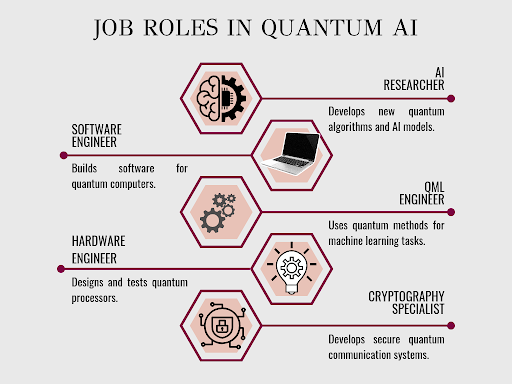
The field of AI is getting bigger and bigger. This means that people who are good at things like intelligence, programming, math, physics and quantum computing can now find new jobs. You can work on projects, make new software, keep computers safe from hackers or even give advice to other companies. There are different types of jobs you can do in quantum AI.
| Company | Country | Quantum AI Focus | Entry Point |
| Google Quantum AI | USA | QML, hardware, algorithms | PhD / Masters |
| IBM Research | USA | Qiskit, quantum algorithms | Masters / PhD |
| Microsoft Research | USA | Topological qubits, Azure Quantum | PhD / Masters |
| IonQ | USA | Trapped ion quantum computing | Masters / PhD |
| Quantinuum | UK / USA | Quantum algorithms, chemistry | PhD / Masters |
| D-Wave Systems | Canada | Quantum annealing, optimisation | Masters |
| Rigetti Computing | USA | Quantum cloud, algorithms | Masters / PhD |
| Amazon Web Services | USA | Amazon Braket, quantum cloud | Masters |
| Bosch | Germany | Quantum AI for automotive | Masters / PhD |
| HSBC / JPMorgan | Global | Quantum finance applications | Masters |
Quantum general intelligence is a big idea that combines quantum computing with artificial intelligence. This artificial intelligence system would be able to do lots of things that humans can do. It would be able to learn, reason and solve problems. It would be able to adapt to different situations.
Researchers are trying to figure out if quantum computing and artificial intelligence can work together to make this happen. They are looking at things like neural networks.
This idea is still pretty theoretical. Some researchers think that quantum computing could be a way to process information. They think it could help make artificial intelligence systems more advanced. Other researchers are not so sure. They do not think that quantum computers are necessary for general intelligence. Quantum artificial intelligence might be good for some problems. Right now we do not know how to use quantum computing to make artificial general intelligence. We do not know when it will happen either.
If we can make quantum general intelligence it will raise a lot of questions. We will have to think about safety, control and privacy. We will have to think about jobs and how it will affect society. For now quantum artificial general intelligence is a long term idea and is not something that is going to happen soon.
Quantum intelligence is exciting and is still a new technology. It has a lot of challenges and we need to understand these. Quantum computing is still developing. It is not ready to replace the intelligence we use today.
These challenges do not mean that quantum artificial intelligence will not work. They just mean that it is still a technology and researchers have a lot of work to do before it can become a reality. Quantum artificial intelligence is still, in its stages.
This is a time for students, professionals and researchers to start learning about quantum artificial intelligence. Students can look into getting a masters degree in quantum computing or a PhD in quantum computing. Professionals who are already working can start with classes and get certified. Researchers can look for programs that give them money to work on ideas and technologies in universities and quantum artificial intelligence laboratories.
Many governments, companies and universities around the world are putting money into quantum artificial intelligence. This shows that people are getting more and more interested in quantum intelligence and quantum computing.
Quantum artificial intelligence may not change everything away but it could make a lot of progress in the next ten years. This is because quantum artificial intelligence is getting better and more powerful. The people who start learning and researching quantum intelligence now could be the ones who shape what quantum artificial intelligence will be like, in the future.
1. Can a student from a non physics background learn Quantum AI?
Yes. Quantum AI can be learned by students who do not have a physics background. It is helpful to have a physics background but it is not necessary. Students from computer science, mathematics, engineering and Quantum AI can also learn Quantum AI by learning the basics of quantum computing.
2. Do I need to be very good at mathematics to study Quantum AI?
You need to have an understanding of mathematics to study Quantum AI. This includes linear algebra, probability and statistics. However you do not need to know mathematics to start learning Quantum AI. You can learn these skills step by step while studying Quantum AI and quantum computing.
3. Can Quantum AI replace AI in the future?
It is unlikely that Quantum AI will replace AI. Classical computers are very useful and will continue to handle many everyday AI tasks. Quantum AI is more likely to work alongside AI to solve certain difficult problems. Quantum AI and normal AI will work together to achieve this.
4. Is Quantum AI already being used in life?
Some companies, universities and research organisations are already testing Quantum AI applications. They are exploring areas such as drug discovery, finance, cybersecurity and optimisation. However most uses of Quantum AI are still at the research or testing stage. Quantum AI is being used in life but it is not yet widely used.
5. What should I learn first if I want a career in Quantum AI?
If you want a career in Quantum AI you should start by learning Python, basic mathematics, machine learning and the fundamentals of Quantum AI and quantum computing. After that you can learn tools such as Qiskit, PennyLane or TensorFlow Quantum. Try small Quantum AI machine-learning projects. You should learn Quantum AI and quantum computing first.
6. Is Quantum AI a career choice for students today?
Quantum AI can be a career choice for students who enjoy technology, science, mathematics and research. The field of Quantum AI is still young so there are more jobs than in traditional AI. However, learning Quantum AI early could create opportunities as the Quantum AI industry grows. Students who learn Quantum AI now may have opportunities in the future.
To further advance academic excellence, IIRF has expanded its reach through diverse initiatives, including ICOSA for school accreditation, study abroad programs, and specialized online courses.