
April 29th, 2026
Education didn’t change overnight, even if it felt that way to many people. For a long time, classrooms followed routines that barely shifted. Fixed schedules, physical attendance and one pace for everyone in the room. Then technology stopped being optional. Access widened. Expectations changed. And suddenly, how learning is delivered became something people questioned instead of accepting.
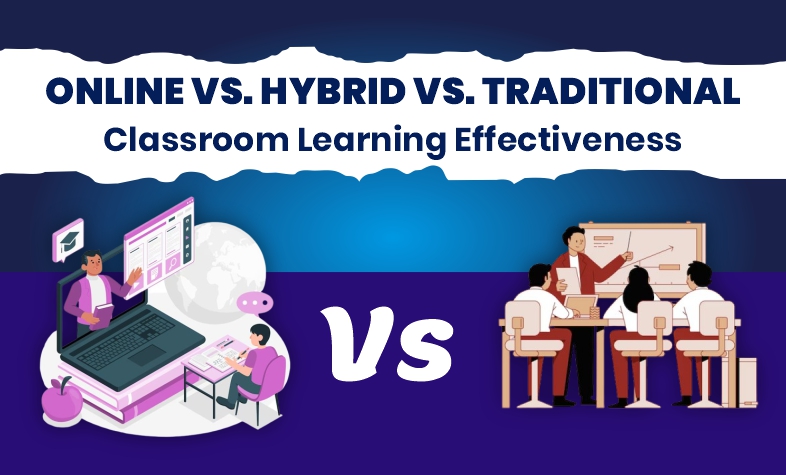
The discussion around online learning vs classroom education is no longer about which one is “better.” That framing misses the point. The real question is how people actually learn, what keeps them engaged over time, and what breaks down when structure disappears or becomes too rigid. The answers are uncomfortable because they aren’t universal.
Classroom learning still works for many students, and it’s not hard to see why. Physical presence creates pressure to show up. You sit among others. You hear questions you didn’t think to ask. You get immediate clarification when something doesn’t make sense. For some learners, that environment provides momentum they struggle to generate on their own.
At the same time, classrooms come with limits that are easy to ignore until they affect you directly. Fixed schedules don’t fit everyone’s lives. Commutes consume time and energy. Teaching moves at a pace set for the average, which rarely suits those who need more time or those who move faster. Students adjust as best they can, but adjustment often means quiet frustration.
Explore and get Insight on Online Learning is The Next Big Trend and Challenge in Education.
Online learning entered this gap offering something classrooms couldn’t: flexibility. Learn from anywhere. Rewatch lessons. Control your schedule. For many students, especially those balancing work, family, or health constraints, this wasn’t convenience. It was access. It allowed people to participate in education who would otherwise be excluded.
But flexibility creates its own problems when it isn’t supported properly. Without physical presence, motivation becomes fragile. It’s easy to log in. It’s easier to disappear quietly. When online learning is treated as a place to upload content rather than a space to guide learning, students drift. Not because they lack discipline, but because the system doesn’t pull them in.
This is where hybrid learning effectiveness became more than a compromise solution. Hybrid models attempt to combine what works from both formats. Digital access for content. In-person interaction for discussion, application, and accountability. When done with intention, hybrid learning allows students to manage time without removing structure completely.
When done poorly, it feels disjointed. Expectations are unclear. Platforms multiply. Communication becomes inconsistent. Hybrid learning doesn’t succeed simply because it exists. It succeeds when there is a clear reason for what happens online and what happens face-to-face.
Explore A Comprehensive Guide to School Education Across Indian States.
Across all formats, one issue keeps resurfacing: digital learning engagement. Engagement online does not happen automatically. Posting slides and recordings is not enough. Students stay involved when participation matters, when feedback arrives before motivation fades, and when interaction feels real rather than symbolic.
Live sessions, discussion spaces, collaborative work, and regular check-ins matter more online than they ever did in physical classrooms. Without these elements, flexibility turns into distance. Distance turns into disengagement. And disengagement often ends in dropout.
Blended education research has consistently pointed to the same conclusion. The medium itself does not determine learning quality. Design does. Research shows that students understand material better when digital tools are paired with human interaction, not used to replace it. It also shows that educators need training to teach differently in blended environments. Transferring traditional methods directly rarely works.
Retention remains one of the most difficult challenges, particularly in online programs. Student retention online drops when learners feel disconnected, uncertain about expectations, or unsure whether their effort is leading anywhere. Convenience alone doesn’t keep students enrolled. Structure does. Relevance does too.
Retention improves when students know what the week requires of them, when someone notices early signs of disengagement, and when progress feels concrete. Systems that assume self-discipline without offering guidance tend to lose students quietly, without obvious failure points.
The mistake many institutions make is treating online and classroom learning as opposing choices. They aren’t. Different students function under different conditions. Some need face-to-face interaction to stay grounded. Others perform best when given autonomy and flexible pacing. Education systems struggle when they insist on uniform solutions for diverse learners.
Technology does not automatically improves education. It does amplifies what already exists. Clear goals become clearer, poor communication spreads faster and strong teaching scales up. Weak design collapses under pressure.
Whether learning happens online, in a classroom, or through a hybrid model, the fundamentals remain the same. Students need clarity. They need consistency. They need support that feels accessible rather than performative. When those conditions exist, engagement improves naturally.
Education will continue to evolve as digital tools become more capable and more common. Platforms will change. Delivery models will shift. What should not change is the focus on how students actually experience learning day to day. Trends matter less than outcomes.
The future of education is now not about choosing sides between formats. It’s about thoughtful integration. When learning systems are built with intention and empathy, they provide more than just access. They give students a more realistic chance to stay engaged, learn meaningfully, and complete what they start.
Check & explore the latest IIRF Ranking 2026, IIRF Engineering Ranking, IIRF University Ranking, IIRF School Ranking, IIRF Design Ranking, IIRF Law Ranking, IIRF MBA Ranking and IIRF MBBS Ranking
To further advance academic excellence, IIRF has expanded its reach through diverse initiatives, including ICOSA for school accreditation, study abroad programs, and specialized online courses.